

A site-level due-diligence lens on what the grid will actually deliver (MW by date, in tranches) and the operating terms that make or break a data center programme.
Executive Summary
- A “power constraint” is rarely a single MW number: it is a local limit (substation/feeder/transformer bay/corridor/grid-code or permit condition) that caps how much load can be energised, when, and on what terms.
- US interconnection risk is dominated by queue outcomes and time uncertainty: Hanwha Data Centers reports only 13% of capacity requesting interconnection (2000–2019) reached commercial operation by end‑2024, and Deloitte cites waits of seven years on some requests.
- UK and EU constraints look different on paper but converge in programme reality: the IEA reports EU connection waits of 2–10 years depending on country, with FLAP‑D hubs averaging 7–10 years; “works duration” figures (e.g., 20–30 weeks) are not the same as queue time.
- Moratoria and “pause” decisions are now an explicit diligence item: Ember reports a de facto moratorium on new Dublin data centers until 2028; ING reports Amsterdam banned new data centers in December 2023 with no new projects expected before 2035; Ember also reports effective bans in Ireland, the Netherlands and Frankfurt until at least 2030.
- The connection offer’s terms are often the real constraint: non‑firm connections (curtailment under defined conditions), phased MW releases, flexibility commitments, and sometimes demand-response or disconnection conditions can be prerequisites to getting any capacity at all.
- A credible plan separates available power today (firm MW, voltage, fault level, power quality, operating conditions) from committed future power (approved MW, reinforcements, dependencies, delivery dates), then ties both to decision gates before land, design freeze, procurement, construction start, or lease execution.
What a “grid constraint” means at one site (not in a market report)
In due diligence, a “power constraint” is not a general statement that “the grid is full”. It is local and specific: a particular substation, feeder, transformer bay, transmission path, land corridor, grid-code requirement, or permitting condition that limits when a defined MW tranche can be energised. The practical question is therefore not “is power available?” but “what MW is offered by what date, in what increments, and on what terms?”
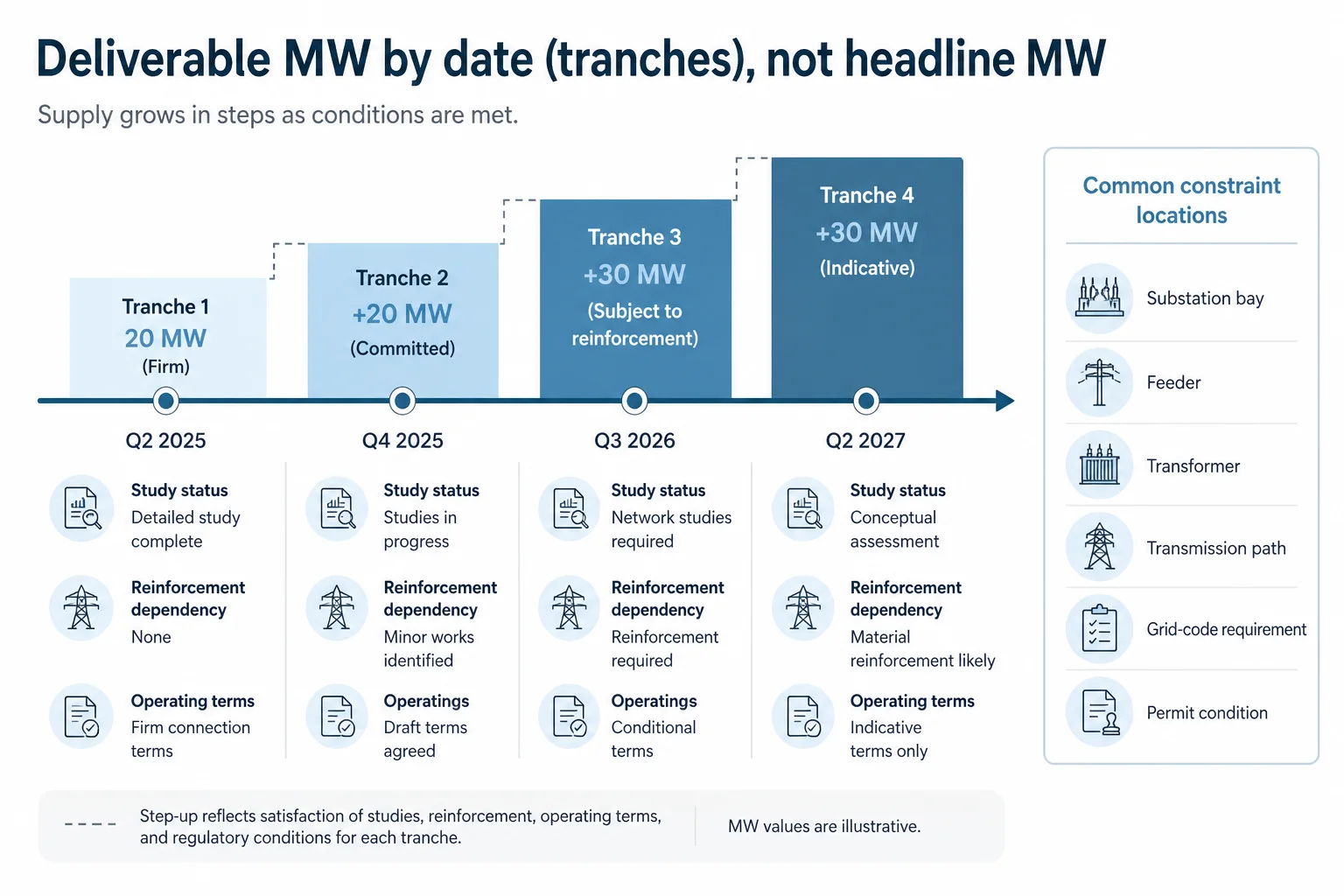
A site can have nominally adequate grid capacity and still be a weak option if (a) the delivery date is uncertain, (b) the supply cannot support the ramping behaviour of the intended load, or (c) temporary power creates permitting or emissions risk. These are not edge cases; they are common failure modes when programme schedules are built on a single headline MW figure rather than on the connection offer’s conditions.
A 100 MW development is often not one power problem. It can be four or five sequential power problems, each with its own grid release, transformer installation, commissioning sequence, load-bank test, customer handover date, and operational risk profile. Treating that as a single “100 MW connection” is how projects end up with stranded build progress.
How long the grid takes in the US (and why “interconnection queue” is the real schedule risk)
In the US, schedule risk is dominated by the interconnection queue: whether capacity progresses through studies and agreements, and whether it survives the commercial and technical filters that cause many requests to withdraw. Hanwha Data Centers reports that of capacity that requested interconnection between 2000 and 2019, only 13% had reached commercial operation by end‑2024 (Hanwha does not name a source for this figure, so it should be treated as Hanwha’s reported statistic rather than a verified system-wide measure).
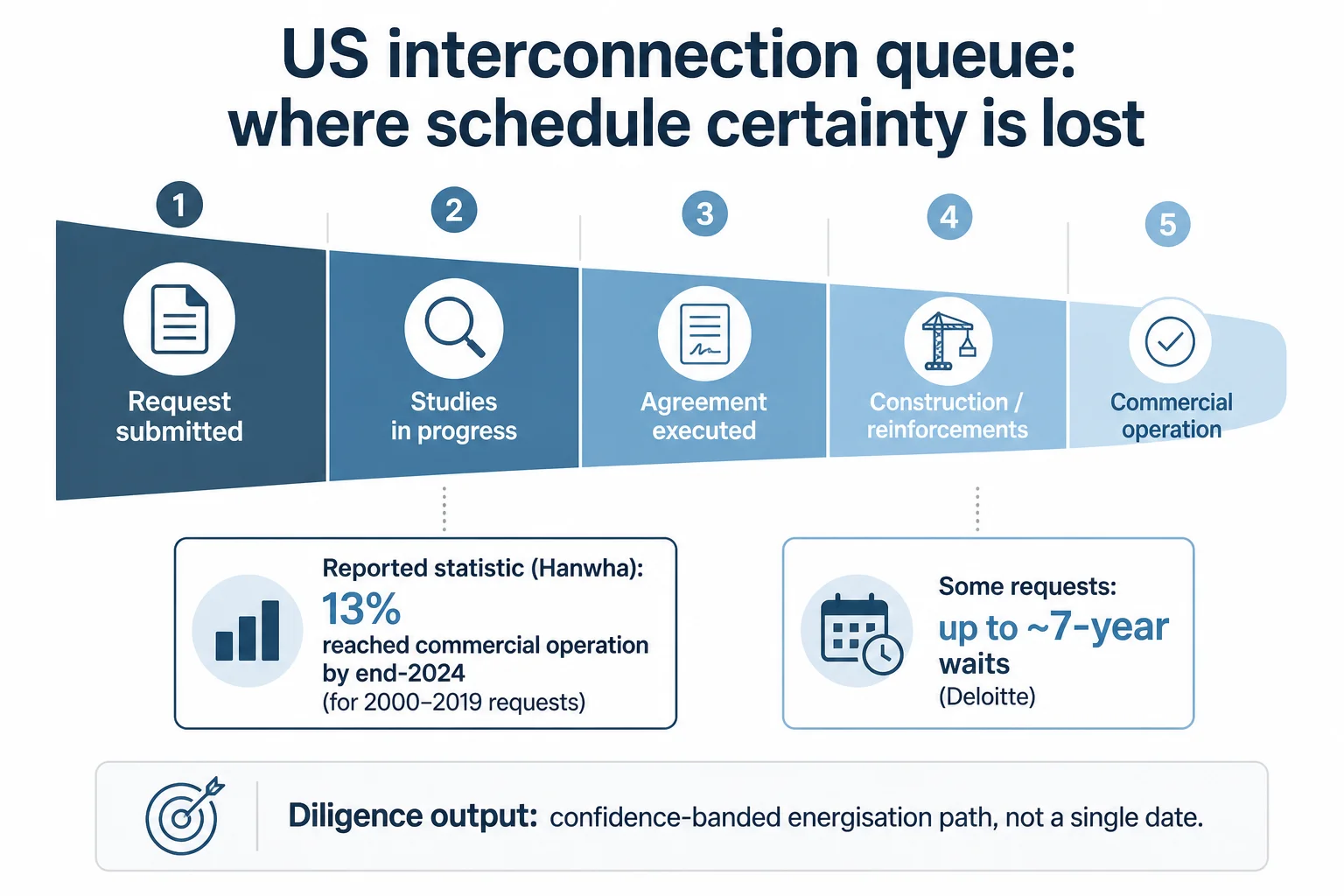
Time uncertainty is equally material. Deloitte reports “a seven-year wait on some requests” for US interconnection. That is not a design-duration problem; it is a gating dependency for land, procurement sequencing, tenant commitments, and financing assumptions.
A practical diligence stance is to treat any single-date “power by X” statement as incomplete unless it is backed by: (1) the queue position and study status, (2) the required network reinforcements and who delivers them, (3) the operating terms (curtailment, ramp, fault level, ride-through), and (4) the commercial commitments required to keep the request live.
US context vocabulary matters because it changes what evidence exists: “large load interconnection” tends to imply a process with defined study stages and milestones, whereas a generic “power availability” claim often collapses those stages into a single headline date. The diligence deliverable is a defensible energisation path with confidence bands, not a single optimistic programme assumption.
How long the grid takes in the UK and Europe (and why “works duration” is not the queue)
UK and European grid constraints often present as connection allocation and reinforcement timing rather than as a single interconnection-queue statistic. The International Energy Agency reports that within the European Union, wait times for securing a grid connection can range from two to ten years depending on country, and that the FLAP‑D hubs average seven to ten years.
Ember’s June 2025 report describes similar time bands for new facilities—seven to ten years on average, and up to 13 years in some primary markets—while also noting materially shorter outcomes in some locations (Italy is cited as “as little as three years”). The diligence point is not the exact number; it is that credible programme planning needs an evidence-backed range tied to the specific connection point.
A common source of misunderstanding is the difference between queue time and delivery works. UK HV connection works are sometimes described as “typically 20 to 30 weeks” once capacity is allocated. That can be true for the physical works stage, but it is not the same as the time it takes to obtain the allocation in the first place. Mixing those two timelines is a repeatable way to underwrite an unachievable energisation schedule.
The UK also has an explicit policy and prioritisation layer. The House of Commons Library reports about 1.6 GW of data-center capacity in 2024 and describes reforms to the connections process, including prioritisation of strategically significant projects such as data centers in AI Growth Zones. The existence of prioritisation does not remove engineering constraints; it changes the evidence a project team must assemble to qualify.
Data Center Moratorium and “no new connections”: when the constraint becomes a planning decision
A moratorium is not “a long queue”. It is a different class of constraint: a pause or restriction on new projects that can override otherwise feasible engineering. For due diligence, that means the grid question becomes: “is new load permitted at all at this location in this timeframe?” before it becomes “how many MW and when?”
Ember reports a de facto moratorium on new data centers in Dublin until 2028. Ember also reports Ireland, the Netherlands and Frankfurt “effectively banning” new data centers until at least 2030; that wording should be treated strictly as Ember’s reported characterisation rather than as an independent statement of fact. Separately, the IEA commentary notes that Dublin and Amsterdam have had to pause new projects citing lack of grid availability.
ING reports that Amsterdam banned new data centers in December 2023, with no new projects expected before 2035. Whether a scheme is “banned”, “paused”, or “effectively restricted”, the diligence implication is similar: programme assumptions that depend on near-term new connections become non-bankable.
US moratoria and local opposition exist too, but they are highly state- and county-specific and often framed through land-use, water, and rate-base debates. For this article’s purposes, the engineering takeaway is that moratoria risk must be logged as a first-order gating item alongside queue time—because it can nullify otherwise strong connection economics.
The terms attached to a connection (including data center demand response) are often the real constraint
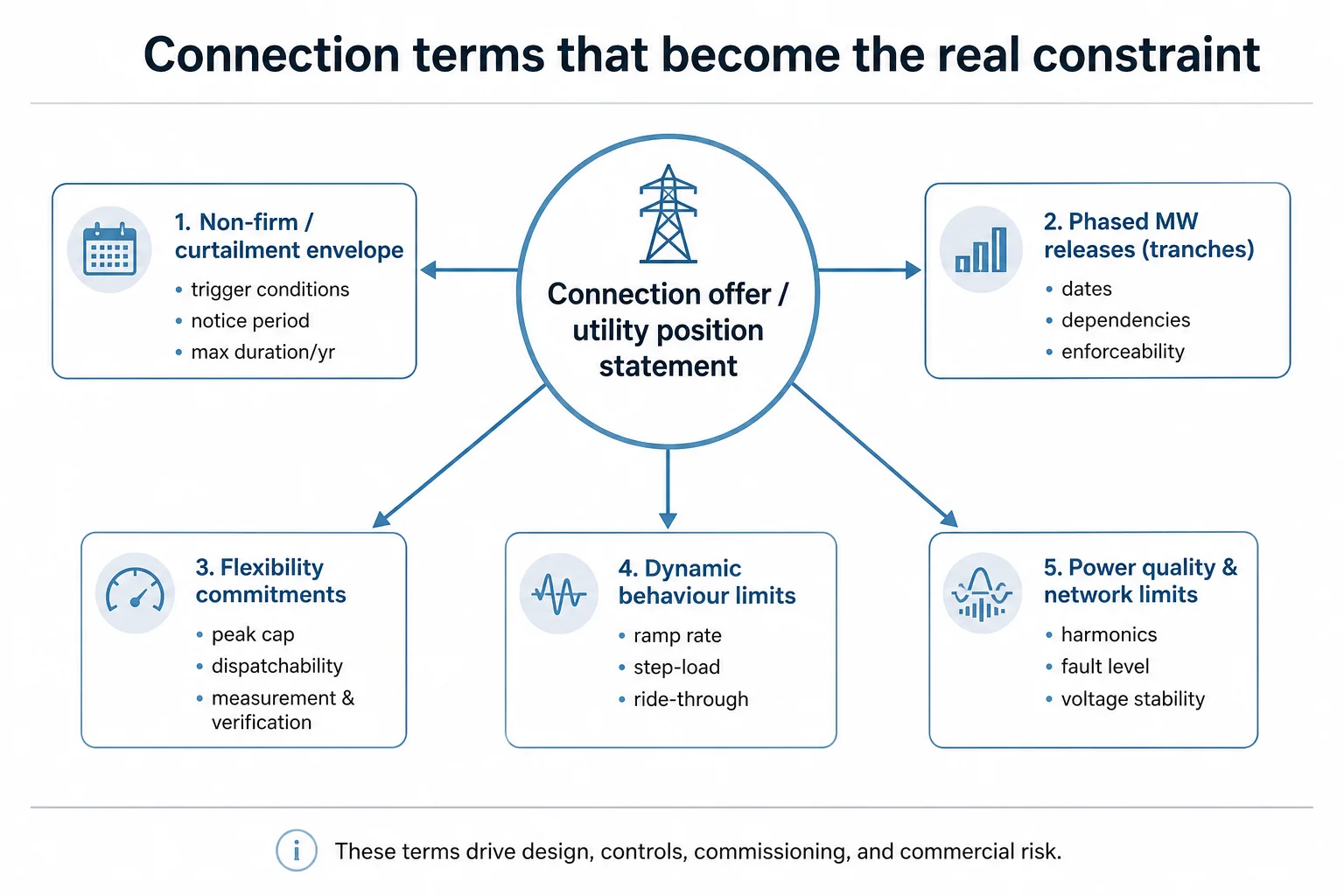
Once a project reaches a connection offer (or an equivalent utility position statement), the constraint often moves from “MW available” to “MW available if the site accepts these terms”. Those terms can be more programme-defining than the headline capacity because they determine whether the load is operable, financeable, and compatible with tenant requirements.
Non-firm connections and curtailment conditions
The IEA describes non‑firm grid connections—where users accept potential curtailment under specific conditions—as a mechanism to accelerate connections in places with constrained grid capacity. Ember notes this is being tested as a short-term response to congestion in markets including Paris and London. For a data center, the diligence question is not whether curtailment exists; it is whether the curtailment envelope is compatible with contracted uptime, resilience philosophy, and any promised service levels.
Phased MW releases: faster access, but only if the tranches are credible
Phased connection approaches can change the economics and schedule of a project, but they are only valuable if tranche dates are realistic and enforceable. Ember reports that a phased approach could purportedly reduce time in the US connection queue by 80%, from 5–8 years to 12–18 months; the “purportedly” matters, because the practical outcome depends on the local network plan and the project’s willingness to accept conditions.
Flexibility commitments and connection cost exposure
The US Department of Energy’s Data Center Load Flexibility Workshop Summary links expedited interconnection for large loads to commitments on flexibility. Deloitte similarly frames load flexibility (including scheduling compute to reduce peak demand) as a practical lever where grid access is constrained. In parallel, connection offers typically carry a cost component—often reinforcement contributions or other charges—alongside the MW and the delivery date; the allocation of that cost can be material even when no single “headline” figure exists at early diligence.
Commercial terms can be as important as technical ones. Ari Peskoe (Harvard Law School), in a Salata Institute interview (17 March 2026), describes AEP Ohio’s data-center tariff (from May 2024) requiring new data centers to sign firm contracts of 10–15 years and pay even if the facility never comes online. Peskoe also reports that after this tariff was introduced, AEP Ohio’s projected data-center demand fell from about 30 GW to about 13 GW as speculative queue entries dropped out. The diligence lesson is that “capacity in the queue” and “capacity that will actually pay and build” are different quantities.
Data center power grid risks: ramp, step-load, fault level, and power quality
Beyond curtailment, network operators may constrain how the load behaves. Large AI/HPC clusters can create faster load changes than the local network is comfortable absorbing without controls or buffering, so ramp-rate and step-load limits can appear as conditions of connection. As load density and electronic conversion increase, harmonics, fault levels, voltage stability, and transient performance become more important at the connection point.
ING cites an incident in Northern Virginia’s Data Center Alley where faulty grid equipment caused 60 data centers to disconnect at once and the area nearly faced a blackout. Examples like this are why utilities and system operators increasingly care about ride-through behaviour and coordinated load response: the risk is system-level, not just a single site’s uptime.
From the connection offer to a phased delivery plan (and the decision gates that prevent stranded capacity)
A power-first plan starts by separating two categories that are often conflated in investment decks: (1) available power today, and (2) committed future power. Available power today is the firm MW that can be energised under defined conditions, including voltage level, fault level, power quality, and any operational constraints. Committed future power is the utility-approved additional MW, with reinforcement requirements, dependencies, and delivery dates.
The phasing logic then maps those tranches to what can be built and commissioned safely. This is where projects either become credible or become “paper feasible”: each tranche needs a commissioning sequence, a load acceptance plan, and a fall-back position if the utility milestone slips.
Decision gates are the control mechanism that stops a project outrunning its power. They state what evidence is required before land acquisition, design freeze, procurement, construction start, or lease execution. Without gates, it is easy to build a completed shell, install switchgear, or even lease a data hall that becomes stranded capacity because the utility supply, backup generation, controls, and cooling plant cannot support live IT load on the required date.
- Gate before land: written utility position at the specific connection point, including MW, date range, and key conditions (curtailment/flexibility/ramp).
- Gate before design freeze: agreed phasing model (MW tranches) mapped to MEP topology and commissioning constraints, with identified failure modes.
- Gate before long-lead procurement: evidence that the next tranche is contractually committed and deliverable (dependencies and reinforcements tracked), not merely “planned”.
- Gate before lease execution: operational envelope confirmed (power quality, ramp, ride-through, curtailment terms) and aligned to tenant requirements.
Architecture choices under the constraint: what each option solves first (and where it fails)
Once the connection offer is understood, the facility’s power architecture becomes a decision under constraint. The point is not to explain how each technology works; it is to state what constraint it addresses first, what it needs to be viable, and where it fails.
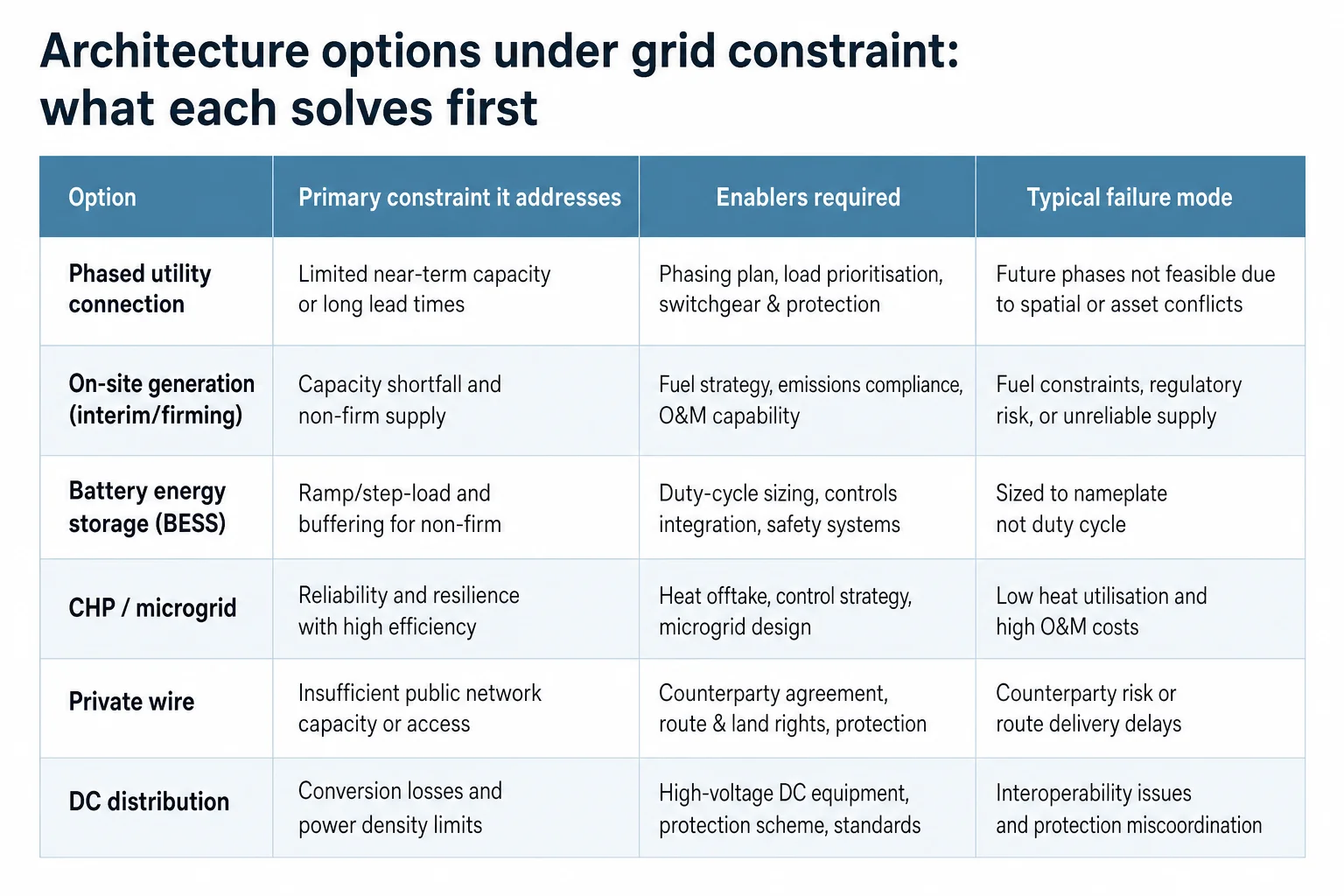
Phased utility connection answers a MW cap by aligning the build-out to a credible tranche schedule. It needs utility milestones that are realistic enough to sequence MEP deployment, commissioning, and tenant commitments; it fails when tranche dates are not credible, because the whole programme inherits the uncertainty.
On-site generation answers a delayed or insufficient connection by providing interim or supplementary firm capacity. It needs fuel supply diligence, emissions and noise permitting, and controls integration; it fails when permitting or fuel logistics are the true constraint rather than the grid.
Battery energy storage can answer ramp limits and short-duration events, and can support a flexible or non-firm connection by buffering the site’s net load seen by the grid. It needs sizing against the actual duty cycle and the interconnection rules; it fails when sized on nameplate rather than on the operating profile it must serve.
CHP or a microgrid answers a need for tighter control over supply and load on a campus. It needs a coherent islanding philosophy, protection and grid-code coordination, and (for CHP) a credible thermal offtake; it fails when the thermal or regulatory case cannot be made, or when the islanding/protection approach cannot be accepted by the network operator.
Private wire answers a public-grid bottleneck by connecting dedicated generation directly to the load. It needs land rights, a workable ownership and operating model, permitting, and regulatory acceptance; it fails on regulation and market rules even when the physical route is feasible.
DC distribution can answer scarce MW by reducing conversion steps and associated losses, but it is not a general retrofit answer and it requires equipment compatibility and a clear protection philosophy. Berkeley Lab’s data center efficiency work notes both the potential efficiency rationale and the practical constraints that limit DC as a default choice.
Demand statistics and forecasts are treated separately in Data Center Power Consumption; for this article, the key is that the requested MW must be matched to the grid’s deliverable MW by phase, not to a single headline capacity number.
Validation scope and a readiness framework for power-constrained sites
A grid-constrained programme fails when the project validates the building but not the grid offer, or validates the grid offer but not the building’s ability to operate within its terms. A diligence-grade validation scope therefore spans both sides of the meter and both technical and commercial evidence.
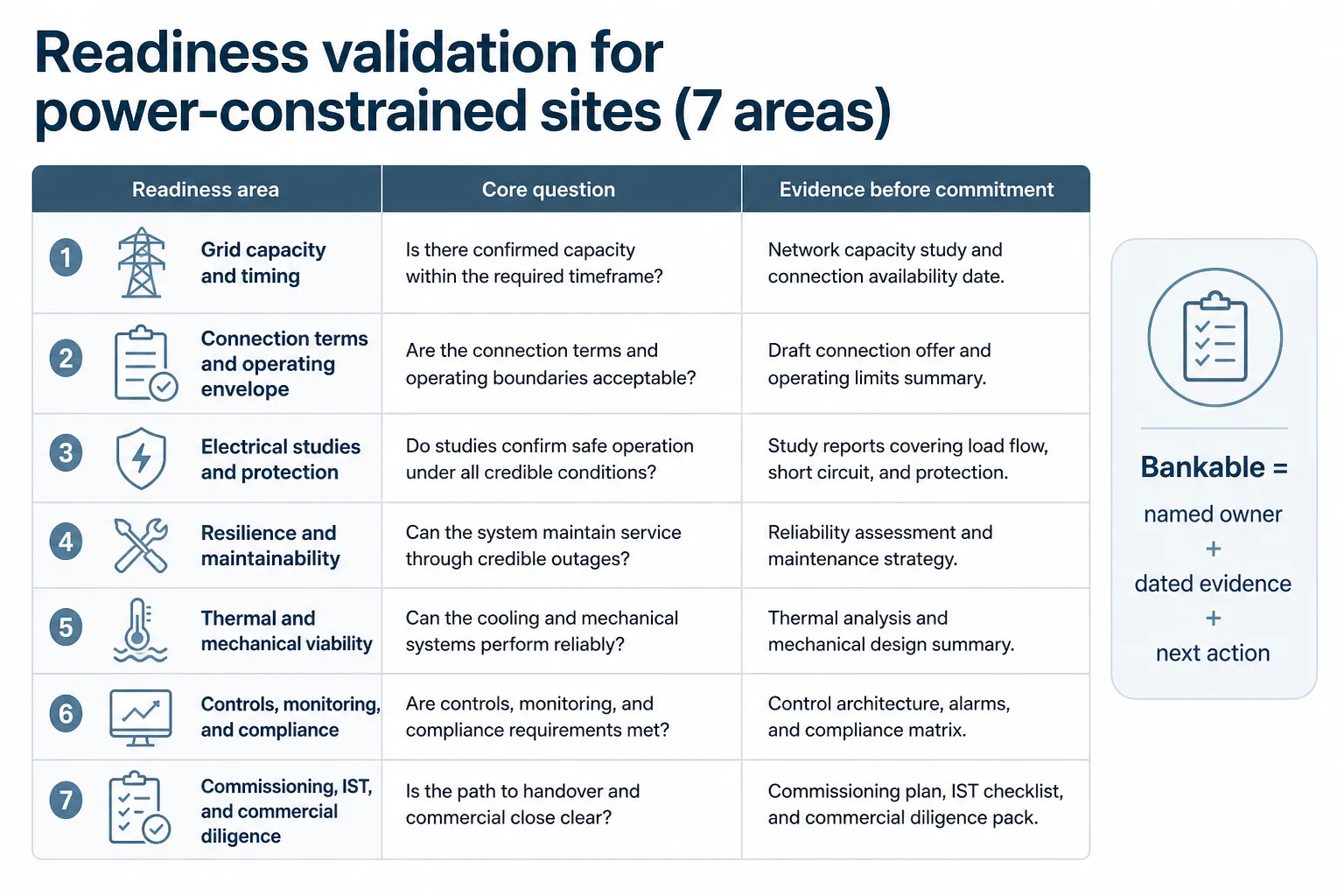
A practical validation scope includes: grid and utility review; electrical system studies (load-flow, short-circuit, protection coordination, harmonics); power-path resilience; power quality and ramp assessment; mechanical and thermal validation; controls and monitoring; commissioning and integrated systems testing (IST); and commercial and due-diligence review.
Interconnection requirements depend on jurisdiction. In the United States, IEEE 1547-2018 is the core interconnection and interoperability standard for distributed energy resources, while other regions rely on local grid codes and distribution or transmission rules that can materially change what is permissible at the point of connection.
Readiness framework: seven areas and the evidence that makes each bankable
The readiness question that anchors the whole assessment is simple: how many MW are available now, contractually committed, and realistically deliverable in each phase? The rest of the framework exists to make that answer defensible.
Decision framework: what to verify before committing to a power-constrained site
For investors, developers, and operators, the key is to turn grid uncertainty into bounded decision gates. The framework below is designed to be applied to one site at a time, using written evidence rather than optimism.
- Lens 1 — Deliverable MW by phase: separate firm MW today from committed future MW; identify reinforcements, dependencies, and the earliest credible energisation date range for each tranche.
- Lens 2 — Connection terms: document curtailment/non-firm conditions, flexibility commitments, ramp/step-load limits, and any ride-through or power-quality requirements; identify what must be measured and controlled.
- Lens 3 — Facility operability: run electrical studies (load-flow, short-circuit, protection coordination, harmonics) and resilience checks against the offered fault level and operating modes; confirm thermal plant and controls can support live load per tranche.
- Lens 4 — Commercial exposure: log costs and obligations tied to the offer (including reinforcement contributions where applicable), long-lead procurement commitments, and the consequence of tranche slippage on leases and revenue.
A site is “ready enough” only when each lens has a named owner, dated evidence, and a clear next action if the utility position changes. Without that, the project is managing a story, not a constraint.
Need a diligence-grade view of connection risk?
Azura Consultancy supports technical due diligence and readiness assessments that test deliverable MW, connection terms, and phase-by-phase energisation credibility.
Where this lands in due diligence and delivery governance
A power-constrained programme is won or lost in translation: from a utility position statement to a phased delivery plan, then from that plan to design governance, procurement sequencing, and commissioning evidence. The work is not only electrical; it is the coordination of grid terms, MEP topology, controls, and commercial gates so the project cannot outrun energisation reality.
Azura Consultancy supports this as independent engineering advisors through technical due diligence, grid-constraint readiness assessments, and delivery governance. Typical outputs include a phase-by-phase energisation plan with confidence bands, a validation scope (studies, commissioning, IST), and a decision-gate pack that investors and delivery teams can use before land, design freeze, long-lead procurement, or lease execution.
- Translate connection offers into tranche-based delivery and commissioning plans.
- Define the minimum evidence set that makes a schedule claim bankable.
- Run electrical and power-quality study scopes aligned to the connection’s fault level and operating terms.
- Stress-test resilience and maintainability assumptions under phased energisation.
Conclusion
Data center power grid constraints are not an abstract market condition; they are a site-specific offer of MW by date, in tranches, with operating terms attached. In the US, the interconnection queue and its withdrawal risk dominate schedule certainty; in the UK and Europe, multi-year allocation and reinforcement timelines, plus moratoria in some hubs, drive similar programme risk even when “works duration” looks short.
A credible project response starts with the terms: non-firm curtailment conditions, phased releases, flexibility commitments, and connection-point limits on ramp, fault level, and power quality. When those are converted into a phased delivery plan with explicit decision gates and a validation scope, the project can move from power optimism to power evidence.
Turn grid uncertainty into decision gates.
For acquisitions, expansions, or new campuses where power timing is the gating risk, Azura Consultancy can define the validation scope and evidence pack needed before commitment.
References
- Overcoming energy constraints is key to delivering on Europe’s data center goals — International Energy Agency (2025-02-01)
- Grids for data centers in Europe — Ember (2025-06-19)
- Data centers: planning policy, sustainability, and resilience — House of Commons Library (2025-01-30)
- Can US infrastructure keep up with the AI economy? — Deloitte (2024-10-01)
- How data centers can be better integrated into the energy ecosystem — ING Think (2024-09-12)
- DOE Data Center Load Flexibility Workshop Summary — U.S. Department of Energy (2025-03-07)
- IEEE 1547-2018 — Standard for Interconnection and Interoperability of Distributed Energy Resources — IEEE (ANSI Webstore) (2018-04-06)
- Direct Current (DC) Power — Berkeley Lab Center of Expertise for Data Center Efficiency (2023-01-01)