

Energy Reuse Factor (ERF) is rapidly becoming a critical metric in data center sustainability. As the global demand for digital services grows, so does the energy footprint of data centers. Even with cutting-edge efficiency measures, the amount of heat and other forms of energy generated in these facilities remains significant.
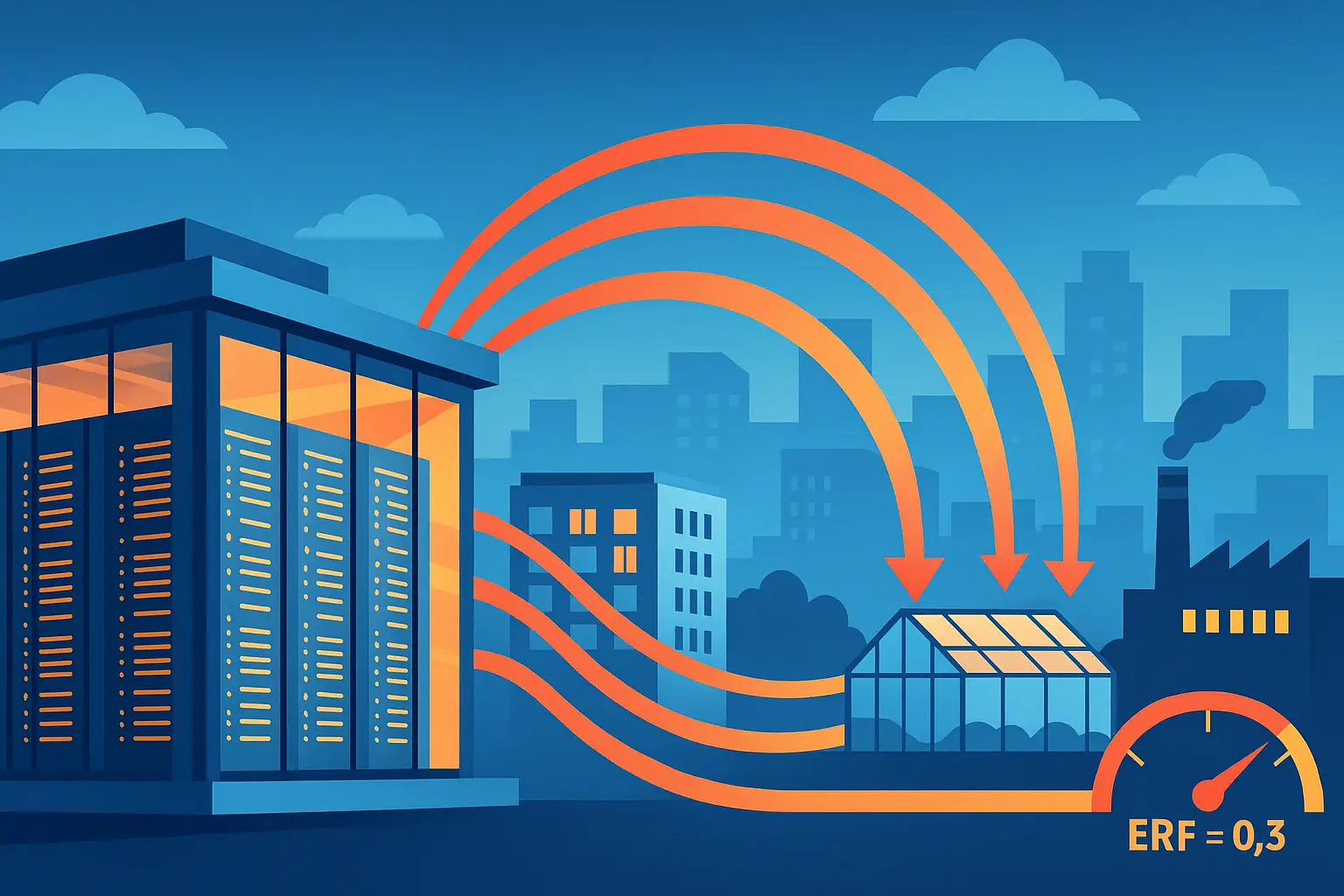
ERF is an internationally recognized ISO/IEC 30134-6 KPI that measures how effectively this energy is reused beyond the boundaries of the data center. By capturing and redistributing what would otherwise be wasted, ERF transforms sustainability goals into measurable impact and even creates new business opportunities.
“The key is that the reuse happens outside the data center boundary — internal reuse (such as heating equipment rooms) improves PUE but does not contribute to ERF.”
1. WHAT IS ERF?
The Energy Reuse Factor (ERF) expresses the ratio of energy reused outside the data center to the total energy consumed within it.
A higher ERF means a facility is making greater use of its “waste” energy — for example, by supplying heat to nearby buildings, district heating networks, or industrial processes.
In essence:
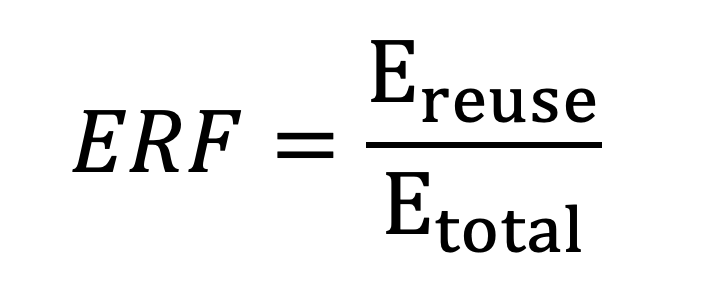
- ERF = 0 → No energy is reused externally.
- ERF = 1 → All energy consumed is reused for beneficial purposes elsewhere (theoretical maximum).
2. ERF - A Simple Example
If a 10 MW data center provides 1 MW of waste heat to a local district heating network, the ERF is:
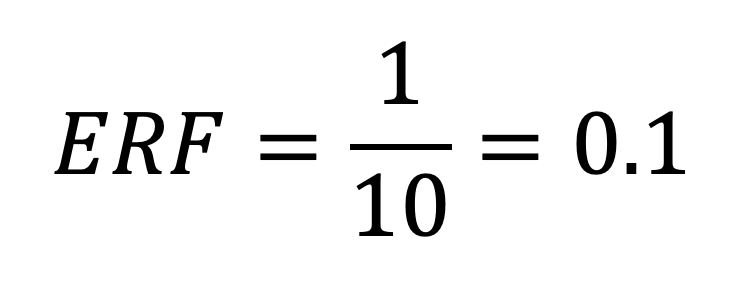
This simple but powerful ratio allows operators to quantify their external sustainability contribution, complementing internal efficiency metrics such as Power Usage Effectiveness (PUE), Carbon Usage Effectiveness (CUE), and Water Usage Effectiveness (WUE).
3. LIFECYCLE CO₂ EMISSIONS REDUCTION WITH ERF
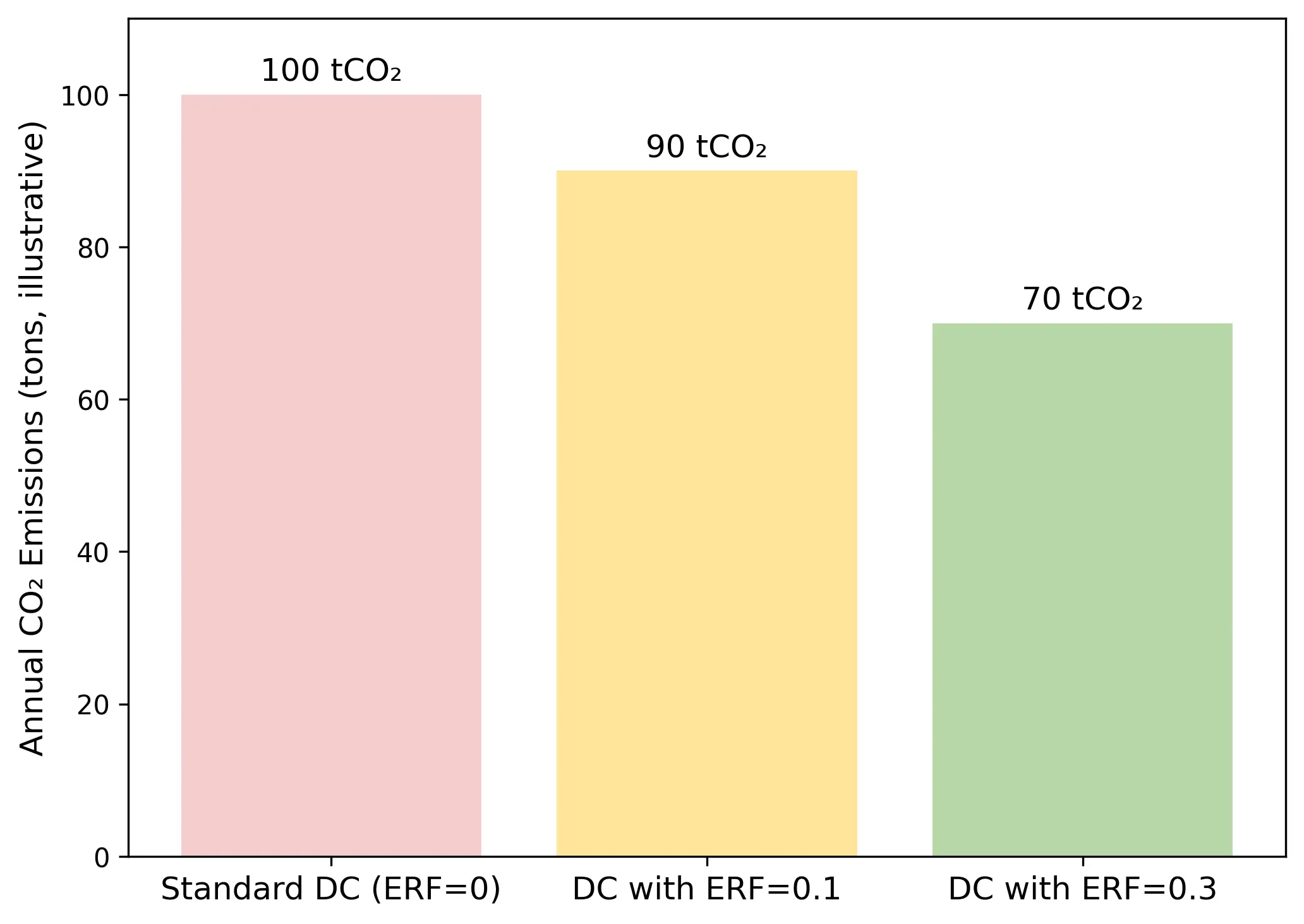
The chart illustrates how implementing Energy Reuse Factor (ERF) strategies can significantly cut a data center’s lifecycle CO₂ emissions. While a standard facility with no reuse has the highest footprint, even a modest ERF of 0.1 delivers measurable reductions, and at 0.3 the carbon savings become substantial. This demonstrates how redirecting waste heat into community energy systems not only supports sustainability goals but also creates tangible climate impact.
4. WHY ERF MATTERS
- Sustainability & Carbon Reduction
- Waste heat reuse directly offsets the need for fossil-based heating or energy generation elsewhere.
- High ERF facilities support local decarbonization targets and contribute to Net Zero pathways.
- Regulatory & Compliance Alignment
Many regions are setting ambitious climate targets, and ERF reporting aligns with emerging compliance frameworks.
- ERF aligns with ISO/IEC 30134 standards and sustainability reporting frameworks like GRI and the EU Taxonomy.
- Regions such as Scandinavia already incentivize heat reuse projects, making ERF reporting increasingly relevant.
- Business Value Creation
- Externalizing waste heat creates new revenue streams through supply agreements with municipalities, greenhouses, or industries.
- Reduces OPEX by balancing load across heating/cooling systems.
- Holistic Efficiency View
- Metrics like PUE measure efficiency inside the data center walls.
- ERF adds the external dimension, showing how your facility benefits the wider community and ecosystem.
5. TECHNOLOGIES THAT ENABLE ERF
- Heat Pumps – Upgrade low-grade heat to useful temperatures for residential or industrial distribution.
- Liquid Cooling – Higher efficiency and easier heat capture for reuse compared to traditional air cooling.
- Absorption Chillers – Convert waste heat into cooling for adjacent office or retail spaces.
- Thermal Energy Storage (TES) – Store waste heat for use during peak demand.
- District Energy Systems – Centralized distribution networks for heating/cooling.
These enablers are already part of Azura’s district energy design services and alternative power solutions, making ERF integration practical and scalable.
6. EXAMPLES OF ENERGY REUSE IN PRACTICE
Some real-world reuse opportunities include:
- Utilizing heat pumps or liquid cooling technologies enables small data centers—such as Edge Cloud facilities, or those in regions with low electricity costs—to reuse waste heat for heating or increase IT density, resulting in reduced cooling expenses and enhanced energy reuse.
- Data centers can supply hot water to residential and commercial buildings, or support district cooling solutions through absorption chillers.
- Supplying hot water or warm air to heat office buildings, greenhouses, or district heating grids.
- Many industries require low-grade heat. Redirecting server heat can displace fossil fuel use at a local factory or plant.
- Smart City Integration – In future urban ecosystems, reused energy can feed into smart city infrastructure, supporting resilience and sustainability.
Note: The key is that the reuse happens outside the data center boundary — internal reuse (such as heating equipment rooms) improves PUE but does not contribute to ERF.
7. HOW ERF FITS INTO DATA CENTRE PERFORMANCE MONITORING
ERF is part of the ISO/IEC 30134 series of data centre KPIs, which provide a structured, globally recognised way to measure and improve energy and resource efficiency.
Tracking ERF alongside PUE, Renewable Energy Factor (REF), and other KPIs gives a more complete picture of a facility’s true environmental performance.
8. ERF IN THE WIDER DATA CENTRE KPI FRAMEWORK
ERF is part of the ISO/IEC 30134 KPI family, which also includes:
- PUE (Power Usage Effectiveness) – Internal energy efficiency
- CUE (Carbon Usage Effectiveness) – Carbon emissions intensity
- WUE (Water Usage Effectiveness) – Water consumption per IT load
Together, these metrics provide a comprehensive view of data center sustainability. An operator that reports PUE and ERF demonstrates not only efficiency, but also how much positive energy contribution the facility makes externally.
9. FUTURE OUTLOOK FOR ERF
- High-Density AI Workloads – As liquid cooling adoption accelerates, higher ERF values will become achievable.
- Policy & Incentives – Expect ERF to play a bigger role in compliance frameworks and renewable energy credits.
- Smart City Integration – Data centers will act as distributed energy hubs, supplying heating, cooling, and even power storage to cities.
In the next decade, ERF could evolve from an “emerging KPI” into a mandatory reporting metric for operators worldwide.
Unlock the Value of Your Data Center Energy
At Azura Consultancy, we help data centres measure, design, and implement Energy Reuse Factor (ERF) strategies that deliver both environmental impact and financial returns.
10. AZURA CONSULTANCY’S ERF EXPERTISE
At Azura Consultancy, we help clients transform ERF from a theoretical metric into tangible sustainability gains. Our services include:
- ERF Assessment & Calculation – Applying ISO/IEC 30134 standards to benchmark your facility, assess and calculate ERF according to international best practice
- Opportunity Identification – Finding cost-effective reuse pathways such as district heating or district cooling.
- Integration with Reporting – Integrate ERF into sustainability reporting, ESG, GRI, and EU Taxonomy frameworks.
- Technical Feasibility & Design – Leveraging our expertise in data centre engineering and technical due diligence to ensure reliable execution.
- Maximize both environmental and financial benefits.
Whether you operate a hyperscale campus or an edge facility, optimizing ERF can unlock new revenue, reduce emissions, and enhance brand reputation. Ultimately transforming your sustainability profile and open up new business opportunities.
11. CONCLUSION
The Energy Reuse Factor (ERF) is more than just a metric — it is a pathway to turning waste into value. By embracing ERF, data centers evolve from being passive energy consumers into active contributors to community sustainability.
Azura Consultancy stands ready to help you assess, design, and implement energy reuse strategies that boost both your environmental performance and business bottom line.
12. FAQS
1. What is the Energy Reuse Factor (ERF)?
The Energy Reuse Factor (ERF) is an ISO/IEC 30134-6 KPI that measures the ratio of energy reused outside the data centre to the total energy consumed within it. It shows how much “waste” energy is converted into useful resources for the community.
2. How is ERF calculated?
ERF is calculated as:
Where:
- E – reuse = energy handed off beyond the data center boundary
- E – total = all energy consumed within the facility (IT, cooling, UPS, lighting, etc.)
3. What’s the difference between ERF and other KPIs like PUE, CUE, WUE?
- PUE (Power Usage Effectiveness): Internal energy efficiency
- CUE (Carbon Usage Effectiveness): Carbon emissions intensity
- WUE (Water Usage Effectiveness): Water consumption per IT load
- ERF: External energy benefit through reuse
Together, these four KPIs provide a holistic view of sustainability performance.
4. Is ERF part of any standard or regulation?
Yes. ERF is defined under ISO/IEC 30134-6:2021 and is included in the EU Energy Efficiency Directive for larger data centres. This makes ERF not only a best practice but also part of regulatory compliance in some regions.
5. Why is ERF becoming important alongside PUE?
PUE has matured, with many operators achieving values close to 1.2. ERF goes further by measuring how data centres contribute to the circular economy, turning heat waste into useful energy for surrounding communities.
6. What technologies enable higher ERF?
- Heat pumps and absorption chillers
- District heating and cooling networks
- Liquid cooling systems (better heat capture)
- Thermal energy storage
7. Are there real-world examples of ERF in action?
Yes. Nordic data centres in Finland, Sweden, and Denmark already reuse waste heat to supply district heating networks and greenhouses, achieving ERF values of 0.2–0.3.
8. What are typical ERF values?
- ERF = 0.0 → No external reuse
- ERF = 0.1 → 10% of energy reused externally
- ERF = 0.3 → Industry-leading values in practice
9. What is a good ERF value??
Any ERF > 0 shows external energy benefit, but industry leaders in Scandinavia achieve ERF values of 0.2–0.3 by supplying district heating.
10. What energy flows can and cannot be included in ERF?
- Counted: Any energy exported outside the facility boundary (heat to a district grid, hot water for nearby buildings, absorption chillers).
- Not counted: Internal reuse (like heating server rooms or offices) — this improves PUE, but not ERF.
11. What are the benefits of reporting ERF?
- Meets regulatory compliance
- Strengthens sustainability reporting (GRI, EU Taxonomy, ESG)
- Creates cost savings or revenue streams from heat reuse
- Builds stronger community and brand reputation
- Provides a competitive edge in sustainability-driven markets
12. Does ERF replace PUE?
No. ERF complements PUE — together they show both internal efficiency and external contribution.
13. How can small data centers achieve ERF?
Edge facilities can connect to local buildings (offices, apartments, greenhouses) via compact heat pumps and storage systems.