

Benefits, Trade-Offs, and Strategic Decision-Making in a High-Growth Market
The global demand for data center capacity is accelerating at an unprecedented pace. Driven by AI workloads, hyperscale cloud expansion, edge computing, 5G, and smart city infrastructure, data centers are no longer niche technical facilities—they are now core national and commercial infrastructure.
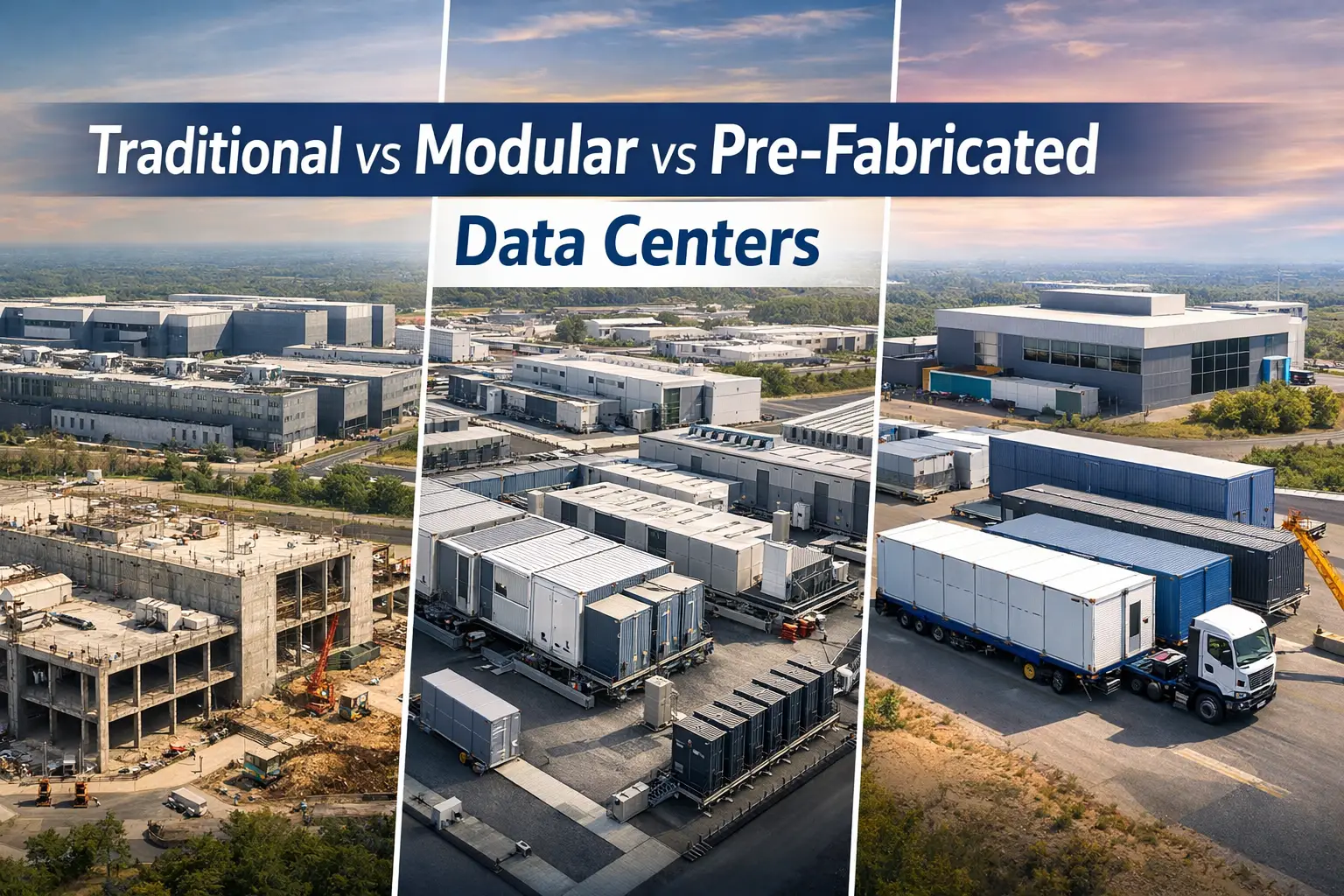
In this environment, one of the most critical early decisions for any data center project is how the facility is built. Traditional concrete, pre-fabricated and modular data centers each offer distinct advantages, risks, and strategic implications. Selecting the wrong approach can lead to delays, stranded capital, scalability constraints, or long-term operational inefficiencies.
This article explores the key characteristics, benefits, and trade-offs of each data center build type and outlines practical data center build strategies for both:
- organizations planning to develop or expand data center capacity, and
- OEM manufacturers positioning pre-fabricated or modular solutions in a rapidly growing market.
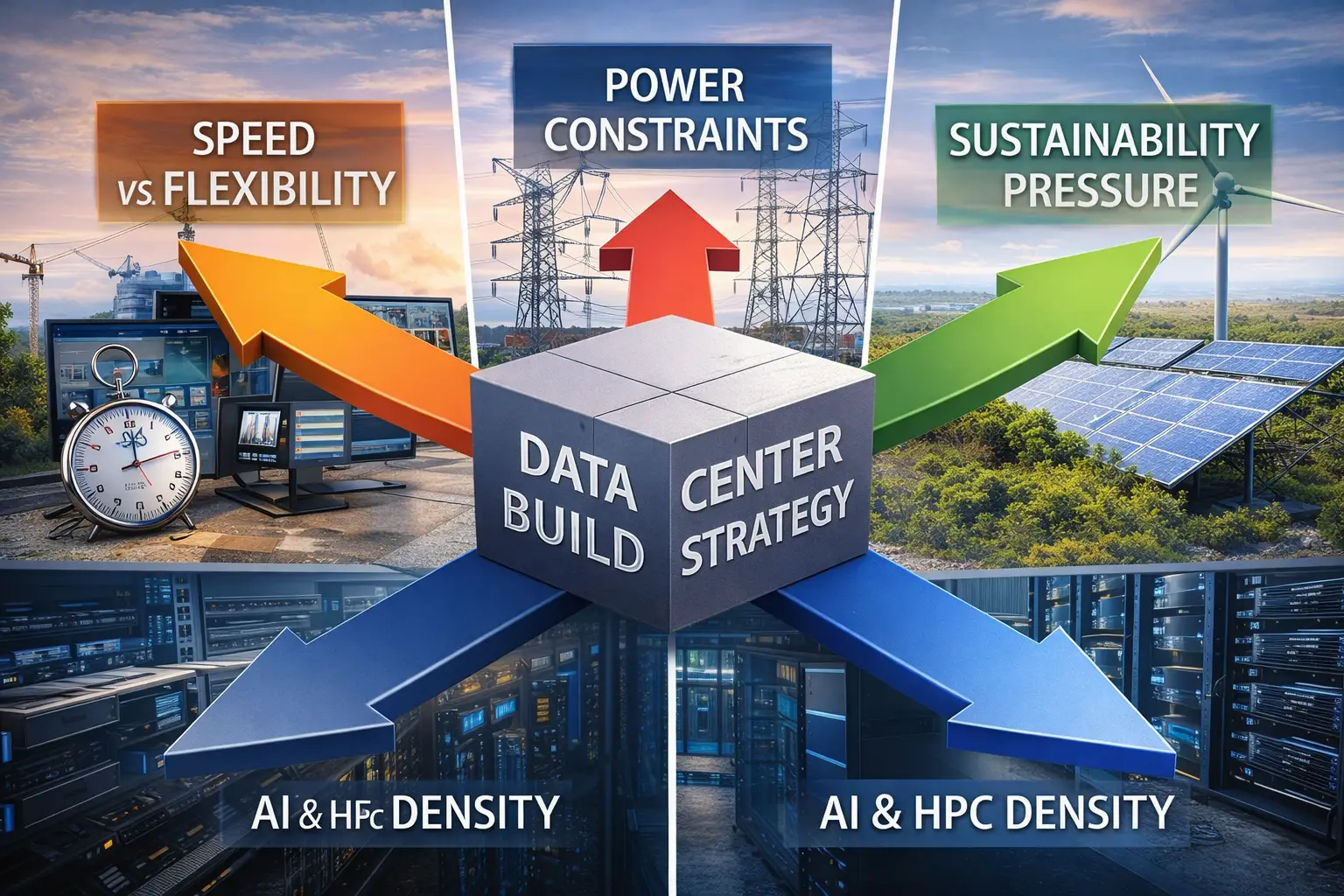
Why Data Center Build Strategy Matters More Than Ever
Historically, data centers were designed as long-term, static assets. Today, the reality is very different. Operators must balance:
- speed to market versus long-term flexibility
- capital efficiency versus customization
- power availability versus future scalability
- sustainability targets versus performance density
As AI and high-performance computing increase rack densities and power demand, and as grid access becomes more constrained in many regions, the construction model itself has become a strategic lever, not just an engineering choice.
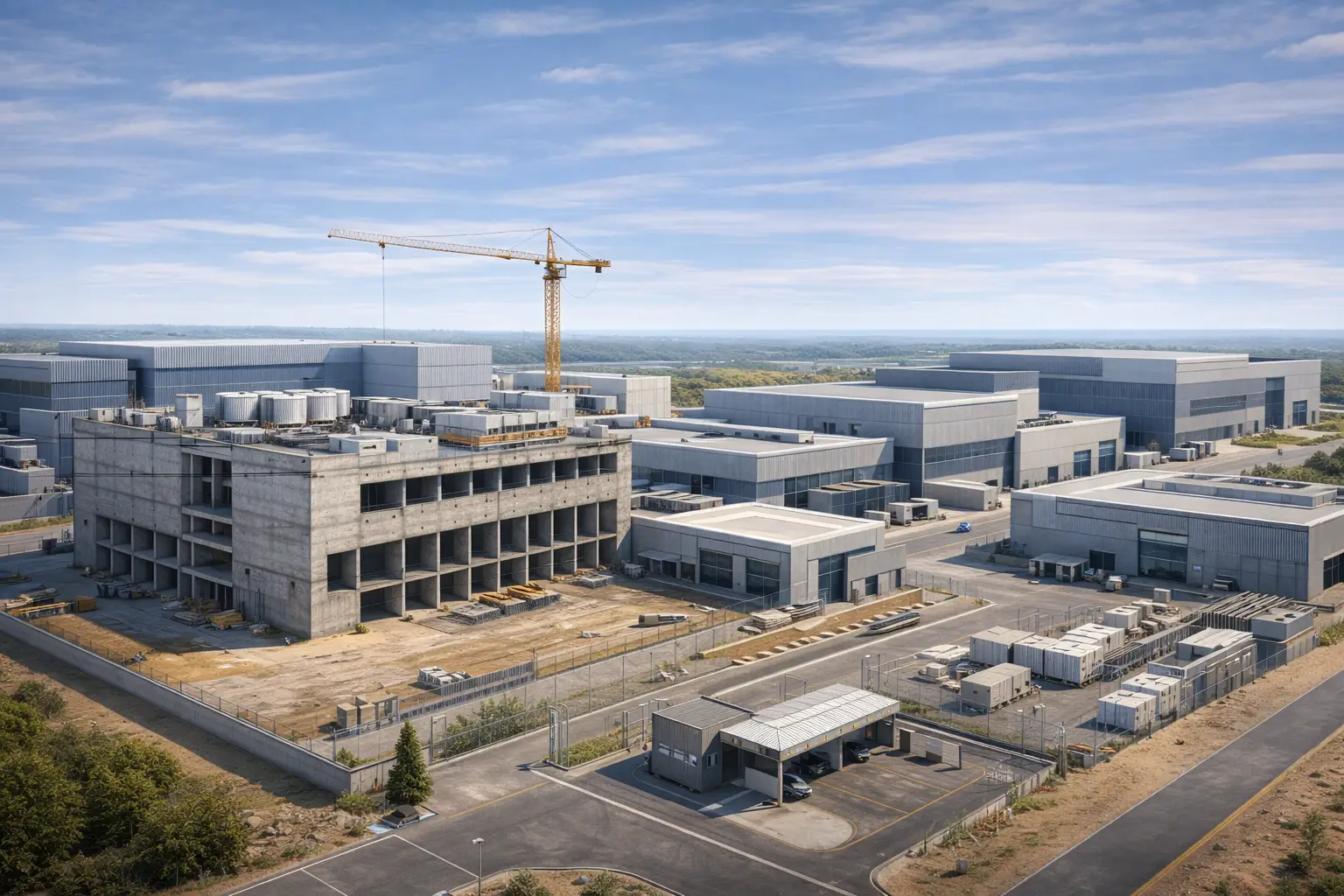
Traditional Concrete Data Centers
What They Are
Traditional concrete data centers are custom-designed, site-built facilities constructed entirely on location. These projects typically involve long planning cycles, bespoke architectural and structural design, and extensive on-site construction.
Key Benefits
- Maximum design flexibility for layout, power density, and cooling architecture
- Well-suited for hyperscale campuses and long-term national infrastructure
- Easier integration of very high-density AI and HPC environments
- Long asset life with fewer physical constraints
Key Limitations
- Longest time-to-market
- High upfront capital expenditure
- Increased exposure to permitting, labor, and supply-chain risk
- Limited flexibility once built
Best-Fit Use Cases
- Hyperscale cloud campuses
- Sovereign or government data centers
- Flagship colocation hubs
- Long-life assets with predictable growth profiles
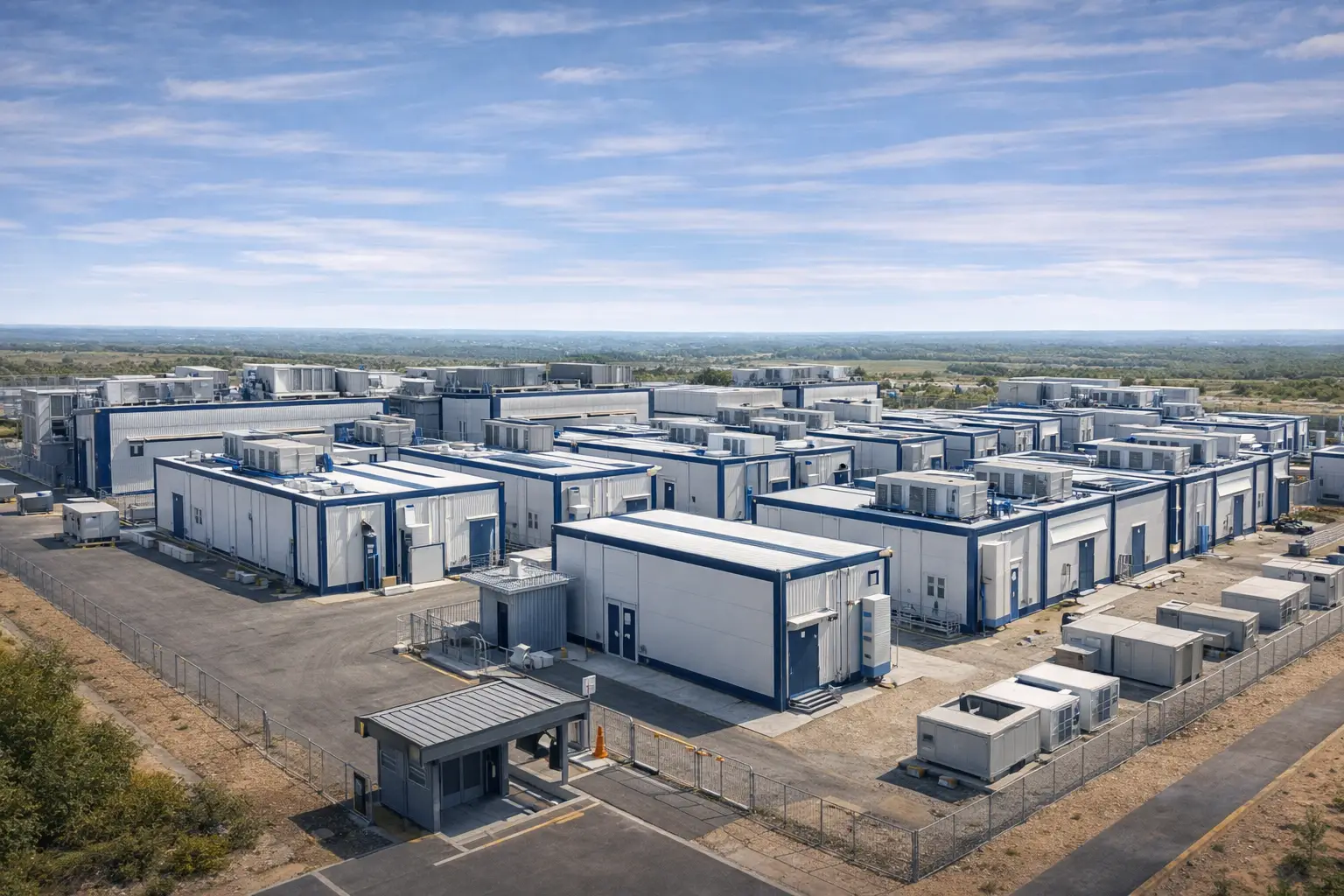
Modular Data Centers
What They Are
Modular data centers use standardized building blocks—either containerized or building-based modules—that can be deployed incrementally. Capacity is added as demand grows, rather than fully built on day one.
Key Benefits
- Faster deployment than traditional construction
- Phased investment, reducing the risk of overbuilding
- High repeatability and standardization
- Easier capacity scaling aligned with demand
Key Limitations
- Physical constraints based on module dimensions
- Campus-level integration requires careful master planning
- Less architectural freedom than concrete builds
Key Limitations
- Physical constraints based on module dimensions
- Campus-level integration requires careful master planning
- Less architectural freedom than concrete builds
Best-Fit Use Cases
- Colocation expansions
- Enterprise private cloud facilities
- Regional hyperscale developments
- Rapidly growing but demand-uncertain markets
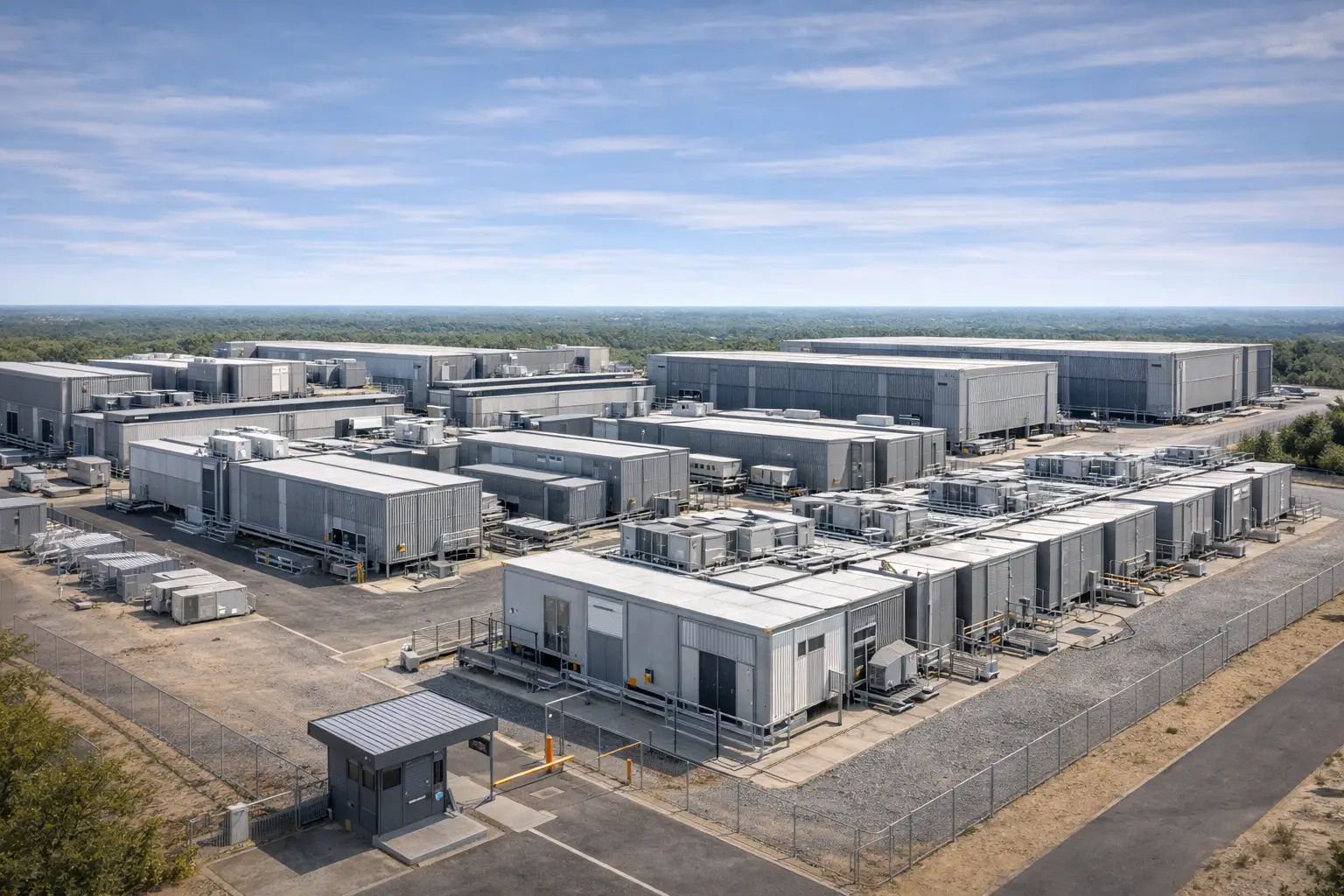
Pre-Fabricated Data Centers
What They Are
Pre-fabricated data centers are largely built in controlled factory environments and delivered to site as fully or semi-assembled units. These may include complete IT halls, power blocks, cooling systems, or integrated MEP modules.
Key Benefits
- Fastest time-to-market
- Predictable cost and quality
- Reduced on-site labor and construction risk
- Strong alignment with standardized designs and rapid deployment
- Well-suited for deployment in regions with limited local skilled labor, installer availability, or challenging site conditions
Key Limitations
- Transportation and logistics constraints
- Limited customization compared to site-built facilities
- Early coordination required for grid, cooling, and site interfaces
Best-Fit Use Cases
- Edge data centers
- AI burst capacity and temporary deployments
- Disaster recovery and backup sites
- Emerging markets with limited construction capacity
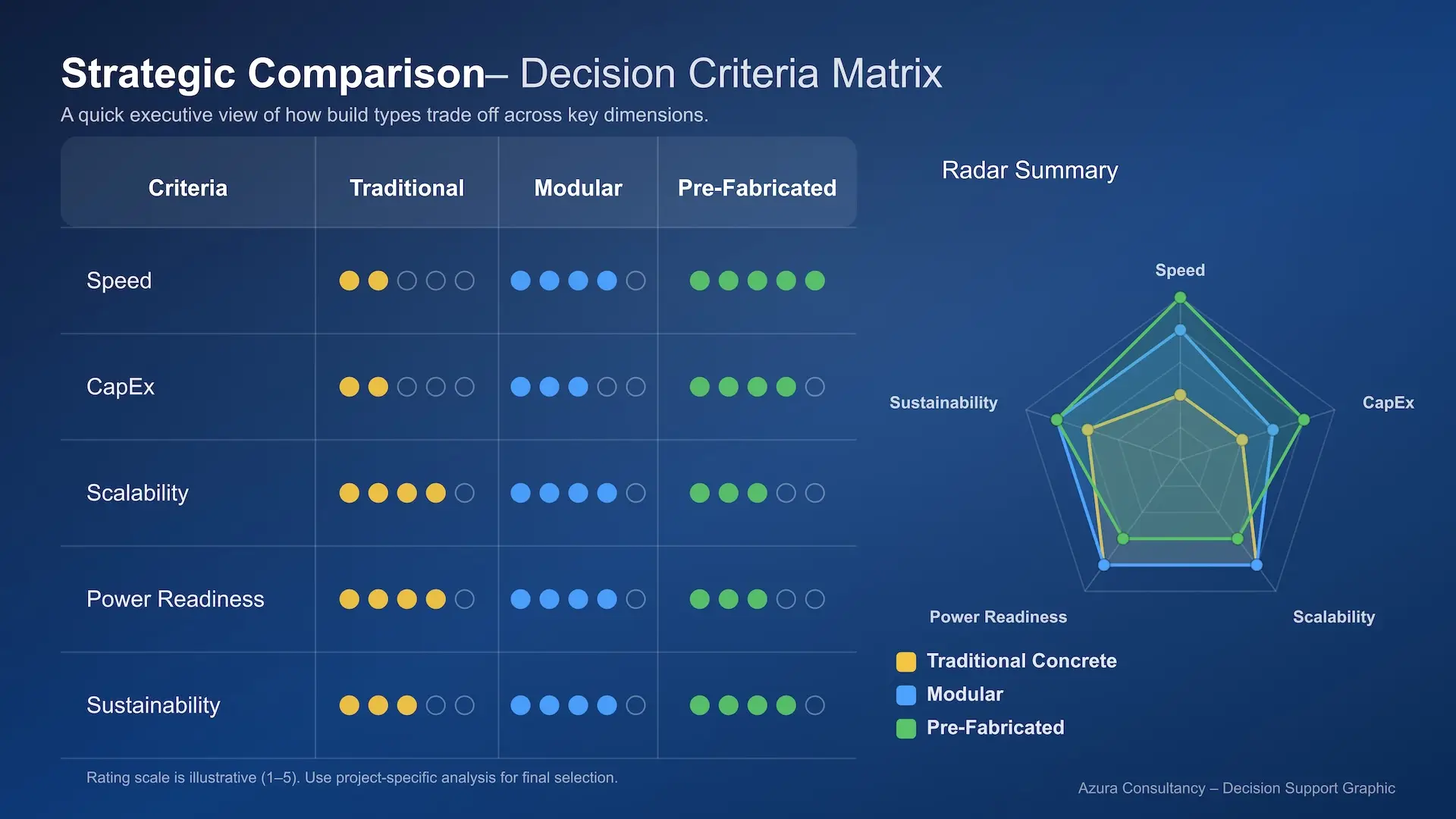
Comparing the Build Models: Strategic Decision Criteria
Rather than asking which build type is “best,” operators should evaluate each option across strategic dimensions:
- Speed to market
- CapEx vs OpEx profile
- Scalability and phasing
- Power density readiness
- Cooling strategy flexibility
- Grid and utility integration
- Sustainability and PUE optimization
- Supply-chain and construction risk
- Long-term adaptability
In practice, many successful developments now adopt hybrid strategies, such as:
- concrete shells with modular MEP blocks
- pre-fabricated early phases followed by permanent builds
- modular expansion within hyperscale campuses
Guidance for Organizations Planning a Data Center
For investors, developers, and operators, the build strategy should be aligned with business realities, not trends. Key questions include:
- How quickly is capacity required?
- Is demand predictable or uncertain?
- What are the power availability and grid constraints?
- How likely are future changes in density, cooling, or IT architecture?
- What is the intended lifecycle of the facility?
How Azura Consultancy Supports Data Center Owners
Azura Consultancy acts as an independent, vendor-neutral advisor, helping clients navigate these decisions with clarity and confidence. Our services include:
- feasibility studies and site selection
- comparative analysis of build models
- power, cooling, and energy strategy development
- technical due diligence for investors and lenders
- Uptime Tier III and IV compliant design
- CFD, energy modeling, and PUE benchmarking
Our role is not to promote a specific construction method—but to ensure that the chosen strategy is technically robust, commercially viable, and future-ready.
Guidance for OEM and Modular Solution Manufacturers
For OEMs supplying pre-fabricated or modular data center solutions, growth depends not only on technology—but on market alignment.
Not every geography, client type, or project profile is suitable for prefab or modular deployment. Successful OEMs understand:
- where speed outweighs customization
- where grid and permitting conditions favor modular solutions
- how products must adapt to local climate, codes, and power constraints
How Azura Consultancy Supports OEMs
Azura works with OEM manufacturers to:
- identify target markets where modular or prefab solutions deliver real value
- validate designs against client technical requirements
- adapt solutions for regional regulations and infrastructure
- support technical evaluations and client due diligence
- bridge the gap between product design and real-world deployment
By acting as a technical translator between OEM innovation and operator expectations, Azura helps manufacturers scale with credibility and consistency.
Market Outlook: The Increase of Hybrid Data Center Strategies
As demand accelerates and constraints tighten, the future is unlikely to be “all prefab” or “all concrete.” Instead, the market is moving toward:
- hybrid campuses
- flexible, phased deployments
- energy-optimized designs
- infrastructure that can evolve alongside AI, sustainability, and regulatory change
Pre-fabricated and modular solutions will play a critical role in meeting growth—but only when deployed strategically.
Make the Right Data Center Build Decision — With Confidence
Azura Consultancy provides independent, engineering-led insight to help data center owners and OEMs choose, design, and deploy the right mix of concrete, modular, and pre-fabricated solutions—aligned to power realities, growth strategy, and long-term risk.
Conclusion: Choosing the Right Strategy, Not the Trend
There is no universal data center build model. The optimal solution depends on business objectives, timelines, power realities, and long-term risk.
Whether you are:
- planning a new data center investment, or
- supplying modular and pre-fabricated infrastructure into a growing market
Azura Consultancy provides the independent engineering insight needed to make informed, future-proof decisions—ensuring that speed, scalability, and sustainability are balanced from day one.