


From Fibre Fundamentals to Coherent DWDM
Executive Summary
- Optical networking is the transport layer that carries very large volumes of data over fibre using light, making it central to telecom backbones, data centre interconnect, subsea systems, and high-capacity enterprise connectivity.
- Fibre fundamentals still matter. Attenuation, chromatic dispersion, PMD, connectors, and splice quality all affect whether a design remains stable, scalable, and commercially viable in practice.
- WDM and DWDM increase capacity by carrying multiple wavelengths over one fibre, but coherent DWDM adds a different level of reach, efficiency, and design flexibility.
- Modern optical decisions increasingly overlap with data centre interconnect, pluggable optics, open line systems, and IP-optical convergence.
- In many real projects, the first bottleneck is not equipment availability. It is route quality, optical validation, interoperability, and internal skills.
- The right next step is not always “buy better optics.” It may be route assessment, design validation, training, or a more realistic architecture choice.
Optical networking is the physical foundation behind modern high-capacity communications. It is what allows networks to carry traffic across metro, regional, long-haul, and subsea routes at scales that would be difficult, expensive, or operationally inefficient with repeated electrical regeneration.
For many people new to fibre, the subject becomes unclear at exactly the point where it becomes commercially important. It is easy to understand that fibre is fast. It is harder to understand how fibre behaviour, wavelength multiplexing, optical impairments, amplifiers, and coherent transport change the design logic of a real network.
This article is for people who want a practical, engineering-led understanding of optical networking rather than a simplified glossary. It is primarily educational, but it is also written to support better design, upgrade, and skills decisions.
At a glance
- Single-mode fibre remains the baseline medium for most high-capacity optical transport.
- WDM and DWDM are methods for multiplying capacity, not separate types of fibre.
- Direct detection suits simpler and shorter-reach cases.
- Coherent transport becomes more relevant when capacity, reach, spectral efficiency, and line-system flexibility become more demanding.
- Validation matters as much as architecture. Optical assumptions that are not checked against route conditions and system constraints often become project risk.
- Team capability matters. Optical transport is not just a hardware choice; it is an engineering and operations discipline.
What optical networking means in practice
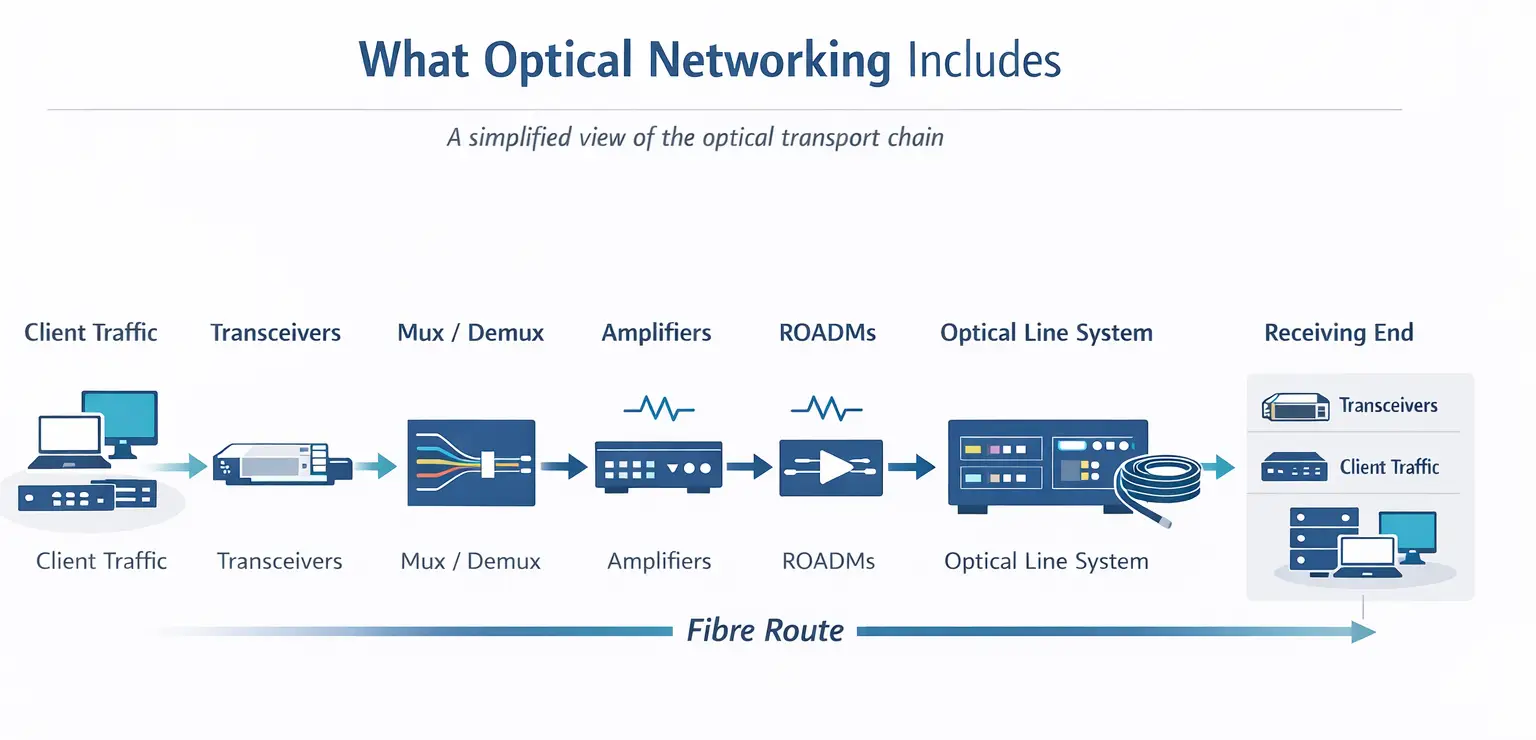
At its simplest, optical networking converts electrical data into optical signals, sends those signals through fibre, and converts them back where needed. In real projects, though, the system is far more than a pair of transceivers and a cable. It includes the fibre itself, patching and splices, optical modules, mux and demux stages, amplifiers, ROADMs, monitoring systems, and often the line system that governs how wavelengths are carried across the route.
This is why optical networking should not be treated as just a transmission medium. It is a design domain with physical constraints, architecture choices, upgrade-path implications, and operational consequences. In metro and long-haul environments, the quality of the design depends on how well the network balances reach, capacity, resilience, interoperability, and future expansion.
In practical terms, optical networking commonly appears in:
- Metro and regional transport networks
- Data centre interconnect
- Long-haul and core backbone routes
- Subsea communications infrastructure
- Utility and transport-network communications
- Enterprise and service-provider fibre infrastructure
The commercial logic is straightforward. Optical networking allows organisations to extract much more capacity from existing fibre routes while maintaining the reach and reliability needed for critical services. The engineering logic is more demanding. The route, fibre condition, optical margin, and line-system design all determine whether that capacity is actually usable.
Fibre fundamentals that still shape modern network design
A common mistake is to jump straight to DWDM, pluggables, or coherent optics without first checking the physical realities of the fibre infrastructure. Fibre is not a neutral, perfect medium. It has loss, dispersion behaviour, connector sensitivity, and route-specific characteristics that affect system performance.
For most beginners, the key fundamentals to know are:
- Attenuation, which reduces signal strength over distance
- Chromatic dispersion, which affects signal integrity as rates rise
- Polarization mode dispersion, which becomes more important in higher-performance systems
- Connector and splice losses, which erode margin
- Reflections and patching quality, which can affect stability
- Fibre type and route condition, which influence the upgrade path
These are not theoretical details. They show up in real projects as reach limitations, unstable margins, failed turn-up assumptions, or the need for more compensation and amplification than initially planned.
A practical foundation review should answer:
- What fibre type is installed on the route?
- What is the realistic end-to-end loss budget?
- Are splice and connector assumptions based on records or on testing?
- Is the route suitable for straightforward optics, DWDM, or a coherent design?
- What hidden constraints could appear during commissioning?
This is also where many organisations realise they have a skills gap. A team that is strong in Ethernet, IP, or general infrastructure may still be underprepared for optical-layer design decisions if it cannot assess attenuation, dispersion, margin, or amplification properly.
From WDM to DWDM: how capacity scaling really works
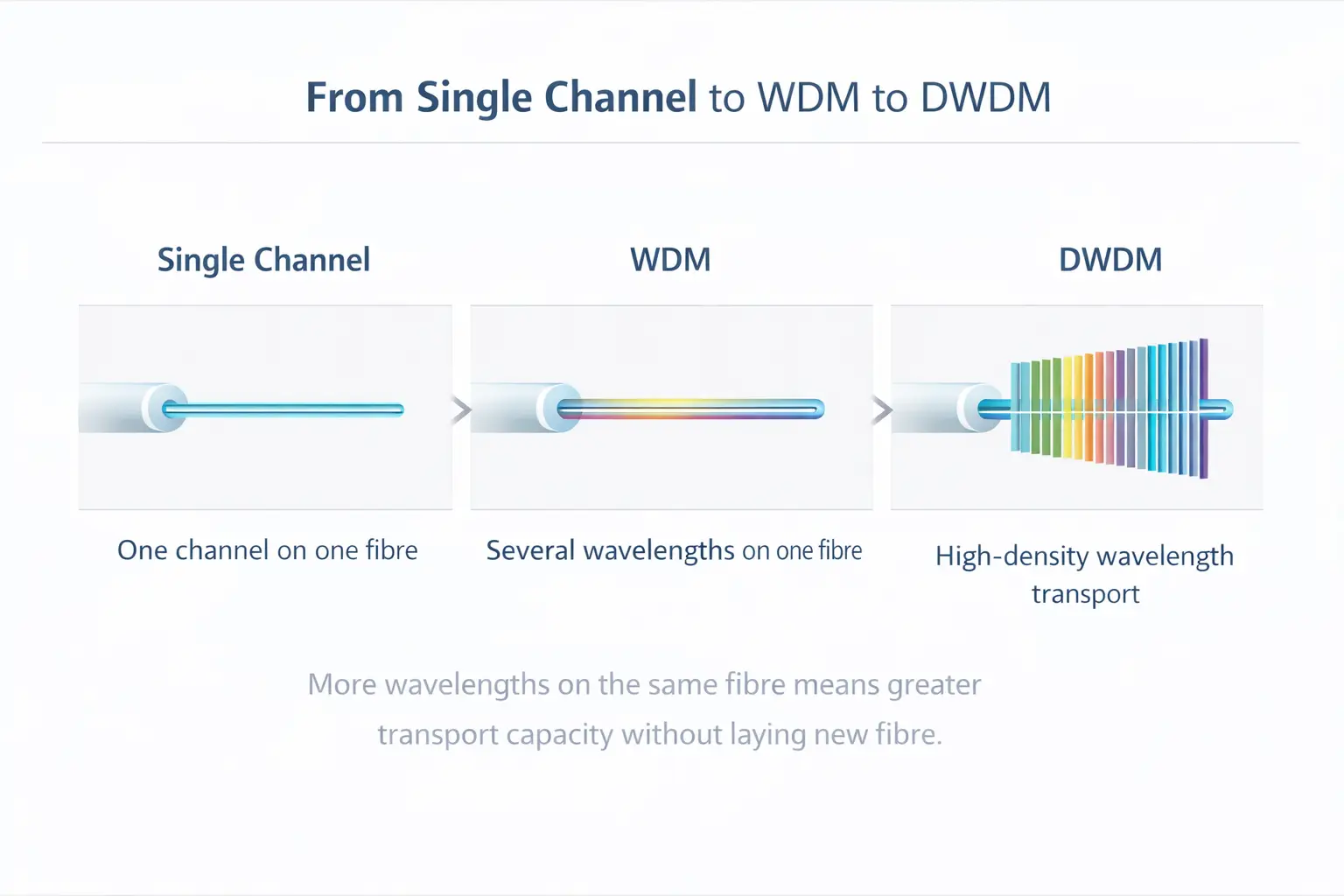
WDM allows multiple wavelengths of light to travel over the same fibre. DWDM applies that principle more densely, so a single fibre can carry far more traffic than it could with one optical channel alone.
The immediate business value is obvious. Instead of laying new fibre every time traffic grows, organisations can expand the usable capacity of the route they already have. That makes DWDM particularly important in metro backbones, service-provider transport, DCI, and subsea systems where route expansion is expensive or physically constrained.
The engineering questions are more nuanced:
- How many wavelengths can the route support reliably?
- What is the upgrade path for future channel growth?
- Where does amplification become necessary?
- How much margin remains once real losses are accounted for?
- Is the design optimised for current demand only, or for phased expansion?
In practice, DWDM is rarely just a bandwidth decision. It is a route strategy, lifecycle, and operating-model decision. A route may technically support more wavelengths, but still become difficult to operate, troubleshoot, or evolve if the design does not account for impairments, line-system behaviour, and interoperability.
Direct detection versus coherent transport
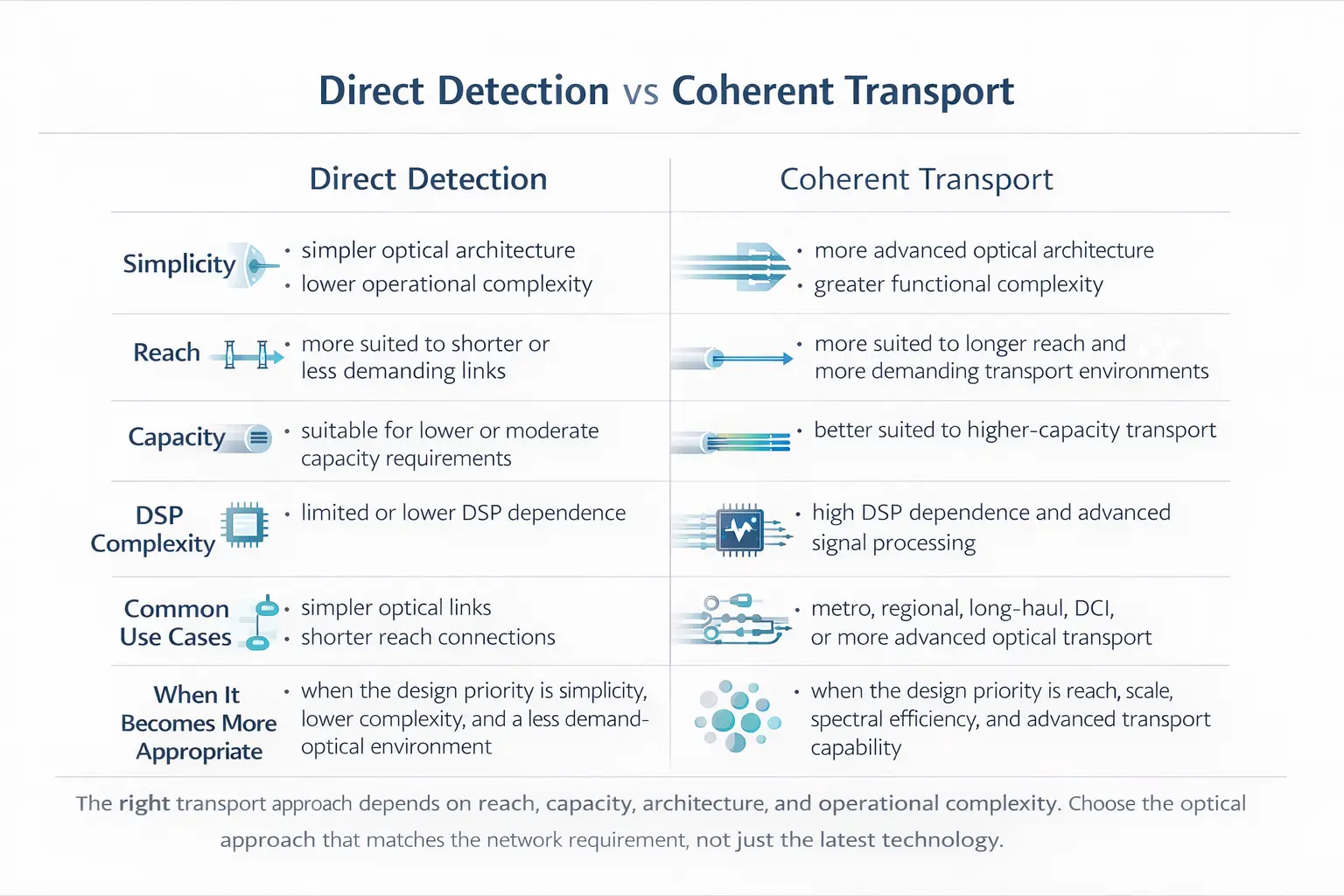
The transition from conventional optics to coherent transport is where many beginners lose confidence, because coherent systems seem to introduce a different class of complexity. That impression is largely correct. Coherent transport is not just “faster optics.” It changes how the network handles reach, spectral efficiency, impairments, flexibility, and telemetry.
A useful practical distinction is this:
- Direct detection is generally associated with simpler optical transmission cases
- Coherent detection introduces advanced digital signal processing and higher-performance transport capabilities
For design teams, the difference matters because coherent systems can make better use of fibre in more demanding transport environments. They are especially relevant where capacity, reach, and flexibility requirements exceed what simpler optical approaches can deliver cleanly.
In practical terms, coherent transport becomes more attractive when the project involves:
- Higher-capacity DCI
- Regional and long-haul transport
- Greater spectral efficiency requirements
- Open line-system or disaggregated transport strategies
- A need for deeper impairment visibility and performance management
Direct detection remains important. It is often the right answer for simpler links, foundation-level learning, and deployment cases where additional coherent complexity brings little real benefit.
The engineering decision is rarely ideological. It is usually contextual. The route, service profile, operating model, and team skill level determine whether coherent transport is justified.
The main constraints and bottlenecks in real optical projects
Optical projects do not usually fail because someone forgot that fibre uses light. They fail because the organisation underestimates the physical, operational, and commercial constraints that sit underneath the design.
The most common bottlenecks are:
- Legacy fibre routes with uncertain quality records
- Optical reach assumptions based on ideal rather than real conditions
- Underestimated splice, connector, and patching losses
- Incomplete understanding of dispersion and nonlinear effects
- Line-system compatibility issues
- Operational teams that can manage IP layers well but lack optical troubleshooting depth
- Overly optimistic assumptions around interoperability and pluggable behaviour
- Upgrade paths that were not validated before the first deployment phase
In converged environments, these issues become sharper. Once IP and optical layers begin to overlap more closely, the system may become more efficient, but it also becomes less forgiving of weak assumptions around reach, thermal limits, line compatibility, or operational skill.
A practical constraints checklist should include:
- Route length and span structure
- Fibre type and route history
- Loss budget and optical margin
- Amplification requirements
- Line-system compatibility
- Operational monitoring capability
- Future growth beyond the initial deployment case
- Internal skills for troubleshooting and optimisation
How optical networking is assessed and validated in practice
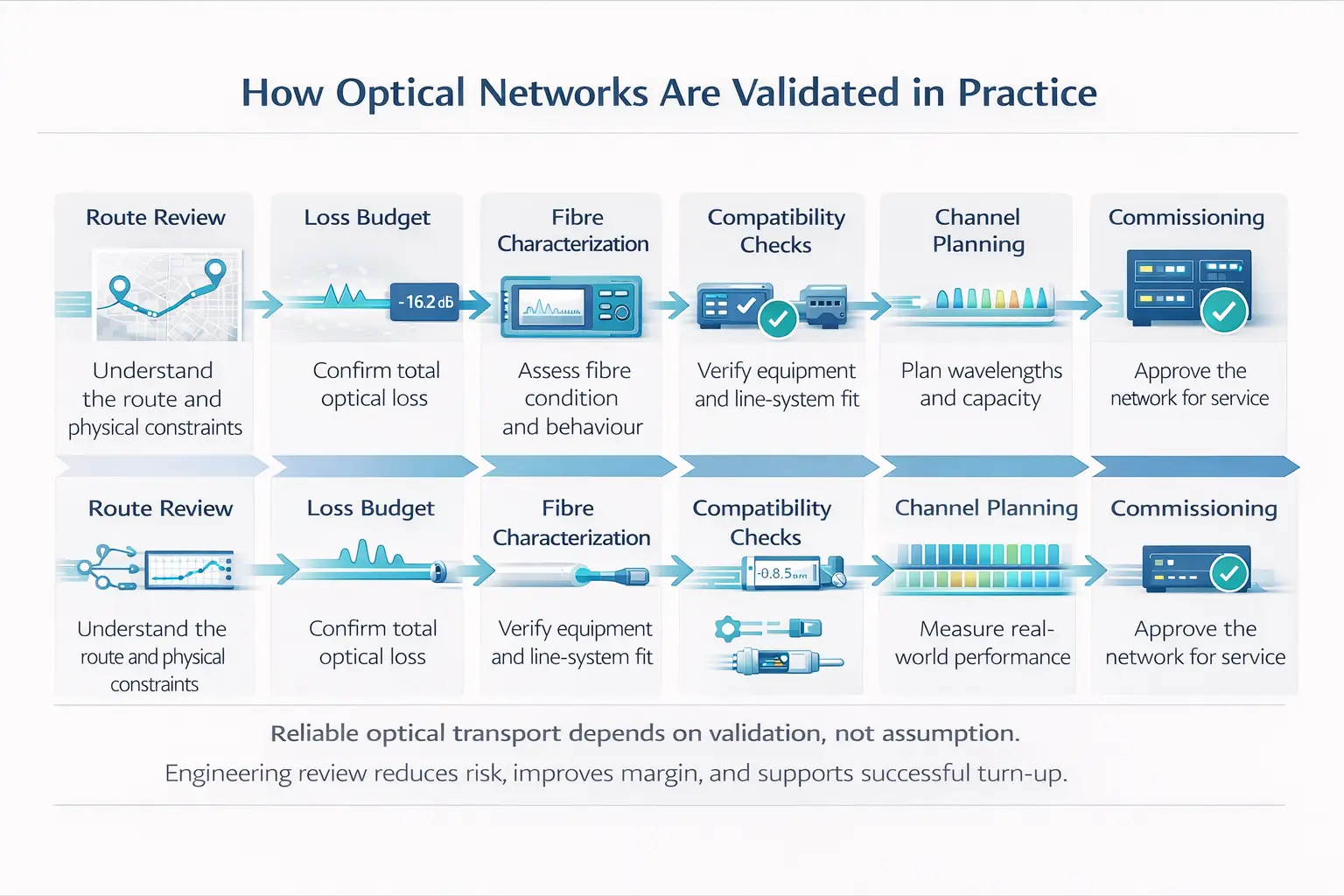
This is where optical networking stops being descriptive and becomes engineering work. A credible optical design is not validated by product brochures alone. It is validated through route assessment, loss and margin analysis, compatibility review, and commissioning discipline.
In practice, the assessment sequence often includes:
- Fibre route review
- Cable and connector quality review
- Optical loss budget calculation
- Dispersion and PMD context check
- Amplification and regeneration strategy review
- Wavelength or channel plan validation
- Compatibility review across optics, transponders, pluggables, and line systems
- Testing and commissioning criteria before service turn-up
Testing and commissioning are particularly important because real routes rarely behave exactly as planning assumptions suggest. A design that looks acceptable on paper can still fail to meet operational expectations if attenuation, dispersion, patching quality, or equipment interaction differs from the model.
Typical validation tools and methods include:
- OTDR testing
- Optical power measurement
- Spectral analysis
- Fibre characterization
- Link validation and commissioning workflows
- Interoperability checks where multi-vendor systems are involved
This validation mindset is also where Azura’s telecom network design perspective is relevant. Route planning, cable selection, splicing logic, testing, commissioning, and subsea or high-capacity transport design are all part of practical optical delivery, not side topics.
Optical readiness: a practical decision framework
Optical readiness is not a yes-or-no question. It is a structured assessment of whether the route, architecture, equipment, team, and operating model are aligned well enough to support a stable optical deployment.
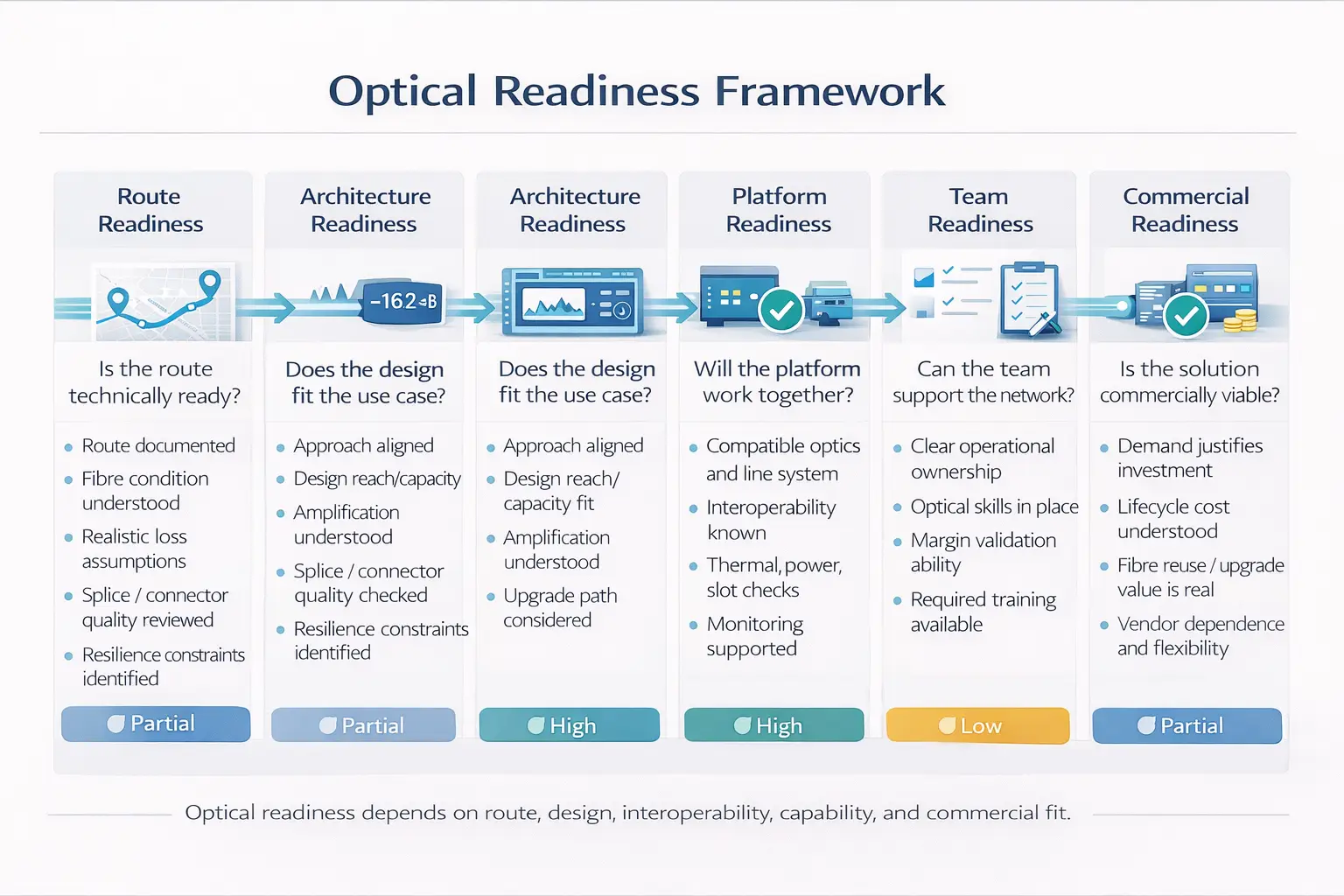
A useful readiness framework is:
- Route readiness
- Fibre route identified and documented
- Physical condition understood
- Realistic loss assumptions established
- Splice and connector quality reviewed
- Environmental and resilience constraints understood
- Architecture readiness
- Direct detection, WDM, DWDM, or coherent approach matched to the use case
- Capacity target aligned with route capability
- Amplification and protection logic defined
- Upgrade path beyond phase one understood
- Platform readiness
- Optics and line system are compatible
- Interoperability limits are understood
- Thermal and power constraints are checked where pluggables are involved
- Monitoring and management systems support the intended design
- Team readiness
- Internal staff can operate and troubleshoot the optical layer
- The organisation can validate impairments and optical margin
- Responsibilities between IP and optical teams are clear
- Training gaps are visible and acknowledged
- Commercial readiness
- The architecture supports the real demand profile
- Fibre reuse benefits are meaningful, not assumed
- Lifecycle cost and operating complexity are acceptable
- Vendor dependence and future flexibility are understood
This framework helps separate technical possibility from project readiness. Many organisations are technically capable of deploying more advanced optical systems, but operationally or commercially unready to do so well.
Explore Azura’s optical networking training and advisory capabilities
Compare CONA and CONE, or contact Azura about team upskilling, optical design review, or transport-network planning support
How Azura Consultancy Can Help
Azura Consultancy adds value when optical networking decisions need to move beyond general awareness and into practical design, validation, or team capability.
That support is most relevant when clients need help with:
- Telecommunications network design and optical route planning
- Fibre deployment strategy, cable selection, and splicing considerations
- DWDM planning and design
- Optical testing, commissioning, and readiness review
- Subsea or high-capacity transport planning
- Team upskilling through practical, engineering-led optical training
- Determining whether a training foundation route such as CONA or a more advanced route such as CONE is the better fit


Azura’s training offer is relevant because it is closely aligned with the real design and operations challenges described in this article. A beginner who mainly needs fibre fundamentals, attenuation, dispersion, WDM understanding, and design basics is closer to CONA. A more knowledgeable person dealing with coherent DWDM, ROADMs, advanced impairments, open line systems, or high-capacity DCI is closer to CONE.
Practical next steps
If this article reflects an active project, the most useful next steps are usually:
- Define the real use case first: metro, DCI, long-haul, subsea, or enterprise transport
- Establish the physical facts of the route before debating architecture
- Separate direct-detection cases from coherent-transport cases
- Review where the real bottleneck sits: fibre condition, line system, equipment compatibility, or internal skill level
- Validate assumptions with testing and route data rather than vendor shorthand
- Identify whether the organisation needs design support, readiness review, or training before proceeding
If the main issue is internal confidence rather than an immediate deployment, start with the skills question. Many costly optical mistakes originate from teams being forced into advanced decisions before they have a strong enough foundation.
Conclusion
Optical networking becomes easier to understand when it is treated as an engineering decision system rather than a list of technologies. Fibre fundamentals, WDM, DWDM, amplification, and coherent transport all belong to the same practical continuum. The right design depends on route conditions, capacity goals, operational model, and the maturity of the team supporting it.
For many organisations, the real shift is from awareness to action. Knowing that coherent DWDM exists is not the same as knowing whether a route, architecture, and operations team are ready for it. That is where a structured review becomes valuable.
Azura Consultancy helps bridge that gap through practical telecom and optical design perspective, engineering-led training, and support that reduces uncertainty without overcomplicating the decision. Technical engineers who want to build internal optical capability can compare CONA and CONE, or explore Azura’s wider training and advisory support.
FAQ
What is the difference between WDM and DWDM?
WDM is the broad concept of sending multiple wavelengths over one fibre. DWDM is the denser, higher-capacity implementation used where scale, route efficiency, and long-distance transport matter more.
When is coherent transport worth considering?
Coherent transport becomes more relevant when the network requires higher reach, higher capacity, better spectral efficiency, or more advanced transport flexibility than simpler optical approaches can provide economically or operationally.
What usually causes problems first in optical projects?
The first problems are often route-related rather than product-related: uncertain fibre condition, underestimated loss, poor splice assumptions, weak interoperability review, or insufficient internal optical skills.
Do all teams need advanced coherent-optics training?
No. Some teams first need a strong foundation in fibre behaviour, optical impairments, WDM methods, amplifiers, and practical design rules. Advanced coherent and disaggregated transport training is more appropriate once those fundamentals are secure.
References
- ITU-T G.652 is currently in force in its 08/2024 form and remains the right reference point for baseline single-mode fibre characteristics and 1310 / 1550 nm operating context. [1]
- OIF’s 400ZR implementation agreement is currently available in version 03.0 dated October 8, 2024, which is the cleanest official source for current 400ZR framing. [2]
- Open ROADM’s official overview frames it as a disaggregated optical networking architecture intended to enable open, scalable, flexible networks and vendor interoperability while reducing vendor lock-in and lowering ownership cost. [3]