

Data center infrastructure across the Middle East and North Africa (MENA) is moving from “capacity build-out” to strategic, energy-led infrastructure planning—driven by AI demand, cloud adoption, national digital sovereignty agendas, and increasingly strict sustainability expectations.
By 2030, many MENA markets will be judged not only by uptime and latency, but by how intelligently they integrate power, storage, cooling, and grid partnership in some of the world’s harshest operating conditions.
"Renewable energy is no longer a backdrop — it’s becoming a primary enabler"
Solar has always been an obvious advantage in MENA. What’s changed is the scale and seriousness of execution, particularly in the UAE and Saudi Arabia, with Oman accelerating quickly behind them. The UAE continues to push high-ambition Green Agenda energy programs and policy frameworks toward 2030.
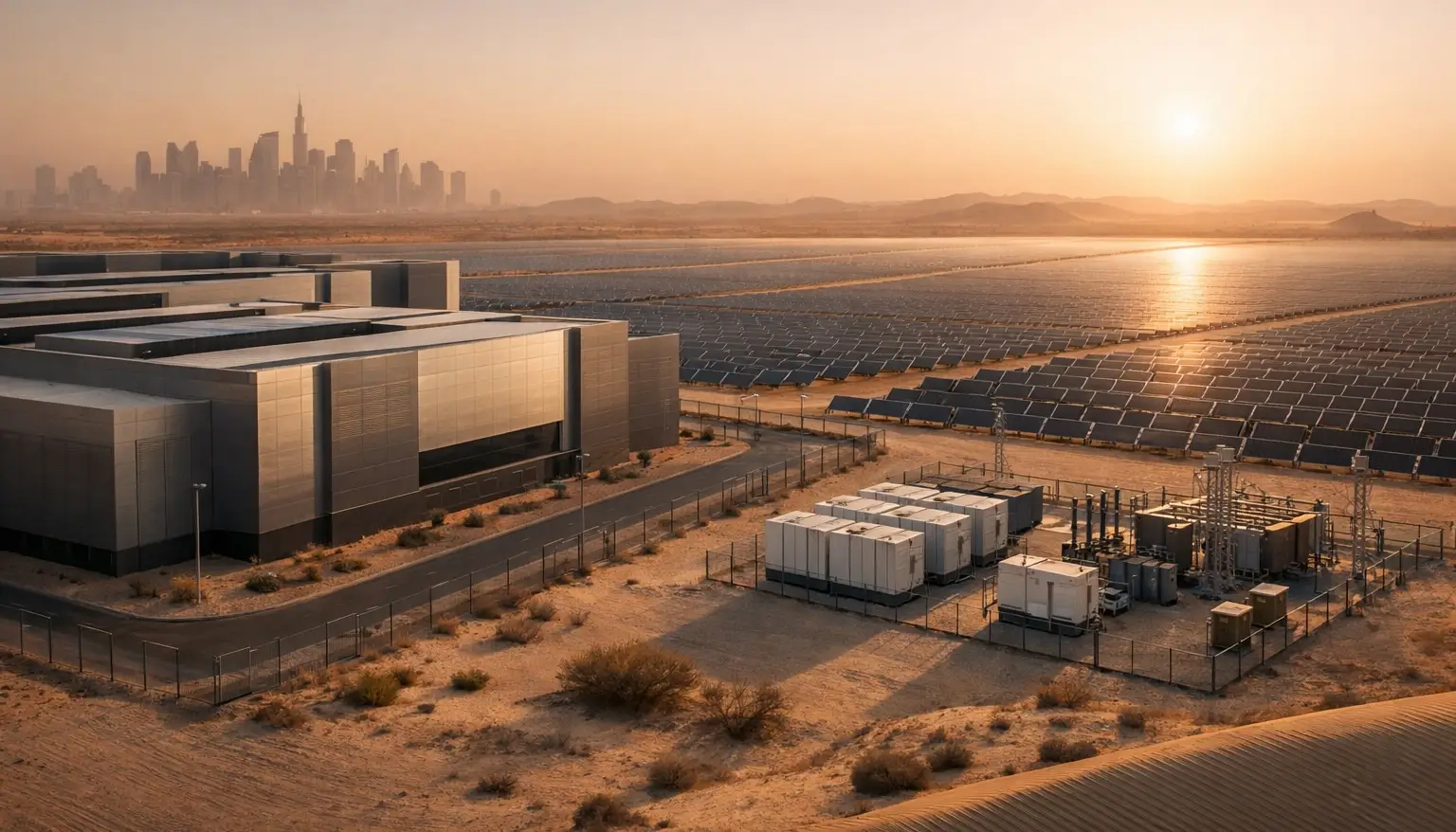
A clear example of this shift is Dubai’s move toward utility-linked green compute. In January 2026, construction updates highlighted a solar-powered green data center in Dubai’s Warsan district, developed by Moro Hub (Digital DEWA), with overall capacity described as exceeding 100 MW.
This matters because it signals a practical step beyond offsets and RECs—toward direct coupling of digital infrastructure to renewable generation at meaningful scale.
Grid stability and storage are becoming core design constraints
True sustainability in MENA data centers is not just about adding renewables—it’s about operating through intermittency, peak pricing, and grid events without compromising resilience. That’s why energy storage is moving from “nice-to-have” to planning baseline.
In Abu Dhabi, Masdar has begun construction of a mega-scale solar-plus-storage project combining 5.2 GW of solar PV with a 19 GWh battery system, with expected online timing reported as 2027.
Projects of this type directly support a future where data centers can contract firmer, more predictable low-carbon power—especially important as AI workloads raise utilization and steady-state demand.
The Sustainability Stack: what “sustainable” really means in MENA data centers
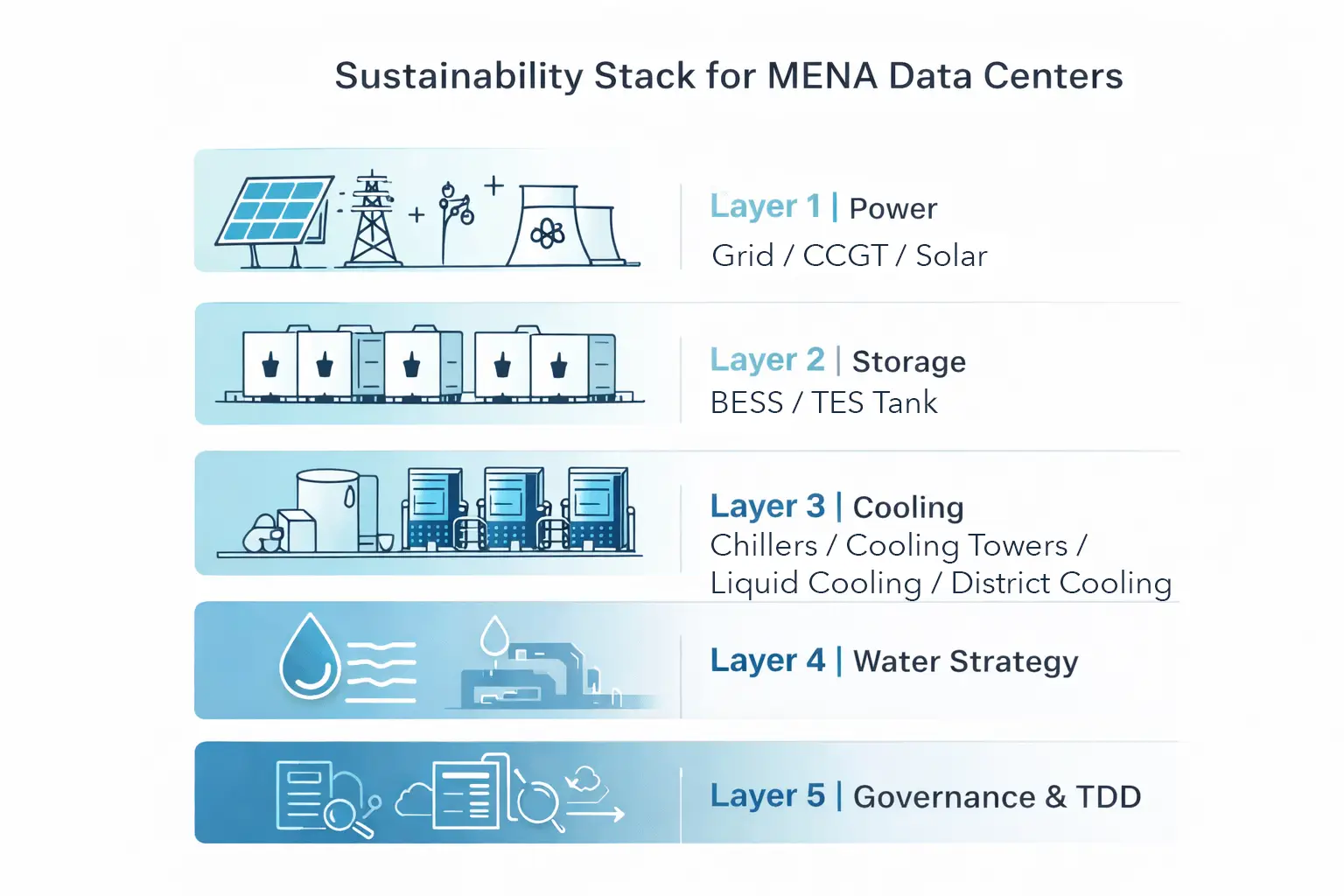
Sustainability in MENA data centers isn’t a single decision like “use solar.” It’s a layered engineering and governance stack—power procurement, storage firming, cooling architecture, water strategy, and project governance—that must work together to deliver resilience and bankability by 2030. The framework below summarizes the five layers that most strongly determine long-term performance and risk.
Cooling innovation is now as strategic as compute
With extreme ambient temperatures and humidity swings, cooling is one of the region’s defining differentiators. The most credible pathways to 2030 combine approaches, including:
- District cooling integration where site conditions and urban planning allow
- Advanced liquid cooling for high-density AI halls (and future rack-level power growth)
- Water-aware design, particularly for markets where water security is a national constraint
- Waste heat recovery where there’s a viable offtake (industrial processes, desalination integration, or community-scale applications)
The trend is clear: operators increasingly need site-specific thermal strategies, not generic “Tier III/IV” templates.
Why the market is accelerating: AI investment and national capacity building
The data center growth story in MENA isn’t only enterprise IT anymore—it’s becoming AI infrastructure economics.
Recent reporting indicates OpenAI is actively exploring very large funding efforts involving Middle Eastern capital, reflecting how the region is positioning itself within the global AI buildout.
In Saudi Arabia, parallel momentum is visible through financing aimed directly at expanding digital infrastructure: Humain (backed by PIF) agreed a framework worth up to USD 1.2 billion, tied to development of up to 250 MW of data center capacity.
This combination—capital + policy + power projects—is what’s reshaping the regional energy mix and the feasibility of large-scale data center pipelines.
GW-scale data center capacity is arriving in MENA
MENA’s data center story is now shifting from “hundreds of megawatts” to gigawatt-scale buildouts—the same capacity language used in established global hubs. The signal is clear: this is not incremental growth. It’s industrial-scale digital infrastructure, backed by multi-billion-dollar programs and designed to support AI-era compute density and utilization profiles.
UAE: from green compute pilots to a 1GW AI infrastructure cluster
A major marker of this shift is OpenAI’s Stargate UAE announcement, which describes a 1GW cluster in Abu Dhabi, with 200MW expected to go live in 2026.
Regardless of operator structure, the headline matters for the market: UAE capacity planning is now framed in GW terms, aligned with sovereign AI ambitions and the power, cooling, and grid coordination required to support that scale.
Saudi Arabia: center3 targets 1GW by 2030 as hyperscale demand rises
Saudi Arabia is signaling similar ambition through Center3 (STC’s data center arm), which is targeting 1GW of data center capacity by 2030.
Importantly, Center3 has also stated an interim milestone of 300MW of total installed capacity by 2027, supporting the idea that this is a staged, execution-driven ramp—not just a long-range aspiration.
What this means: MENA isn’t just investing — it’s building at hub scale
When you combine GW-scale targets with major renewable generation and storage expansion, the Middle East is no longer a “future” market—it’s actively converging with (and in some areas leapfrogging) traditional capacity hubs through large-scale deployment velocity.
The practical implication is that feasibility must now operate at portfolio scale: grid interconnect strategy, firming (BESS), cooling architecture, water strategy, and delivery governance all become decisive constraints—project by project, site by site.
Oman is rising faster than many investors expected
Oman is increasingly part of the “next wave” conversation—supported by national digital transformation direction and a growing pipeline of renewables. Official communications around Oman Vision 2040 have cited an ambition for renewables to contribute around 30% of electricity generation by 2030.
For developers and investors, this is important: it suggests Oman’s data center growth won’t be constrained only by demand—it will be shaped by how quickly grid, generation, and permitting mature together.
The key takeaway: feasibility is now case-by-case — and that’s a good thing
As the region scales, the winners won’t be those who build the fastest—they’ll be those who build bankable, grid-compatible, climate-fit facilities.
That means every serious project needs a rigorous, site-specific view of:
- power availability, pricing structures, and grid interconnection constraints
- renewable sourcing strategy (on-site, off-site PPA, hybrid models)
- storage sizing and control strategy (resilience + economics)
- cooling approach matched to climate and water realities
- delivery risk: supply chain, commissioning, and operations model readiness
How Azura Consultancy supports future-ready MENA data centers
Azura Consultancy helps operators, developers, and investors turn ambition into deployable, financeable infrastructure. Our support spans:
- Feasibility and site readiness studies (power, cooling, land, permitting, scalability)
- Renewables + storage integration strategy (PPA models, hybrid architectures, resilience)
- Thermal management engineering (district cooling, liquid cooling readiness, water strategy)
- Technical due diligence (TDD) for acquisitions, financing, and risk mitigation
- Design governance and delivery oversight to ensure buildability and operational outcomes
Deliver Future-Ready Data Centers Across MENA
By combining engineering depth with practical delivery experience, we help clients realize sustainable, resilient, AI-ready data center programs aligned to 2030 targets—without assuming a one-size-fits-all model.