


From Intelligent Radios to Autonomous Network Infrastructure
Why AI RAN Matters Now
Radio Access Networks (RAN) are undergoing the most significant transformation since the introduction of LTE. Driven by explosive traffic growth, dense 5G deployments, rising energy costs, and increasing service complexity, traditional rule-based RAN optimization has reached its practical limits.
Artificial Intelligence is no longer an experimental enhancement at the edge of the network. AI RAN is becoming a core architectural capability, redefining how radio networks are planned, optimized, operated, and monetized. As networks evolve toward 5G Advanced and lay the foundations for 6G, AI is emerging as the only viable way to manage scale, performance, and sustainability simultaneously.
For operators, governments, enterprises, and private network owners, AI RAN represents a shift from static network design to adaptive, self-optimizing, and increasingly autonomous radio infrastructure.
From Traditional RAN to AI-Native RAN
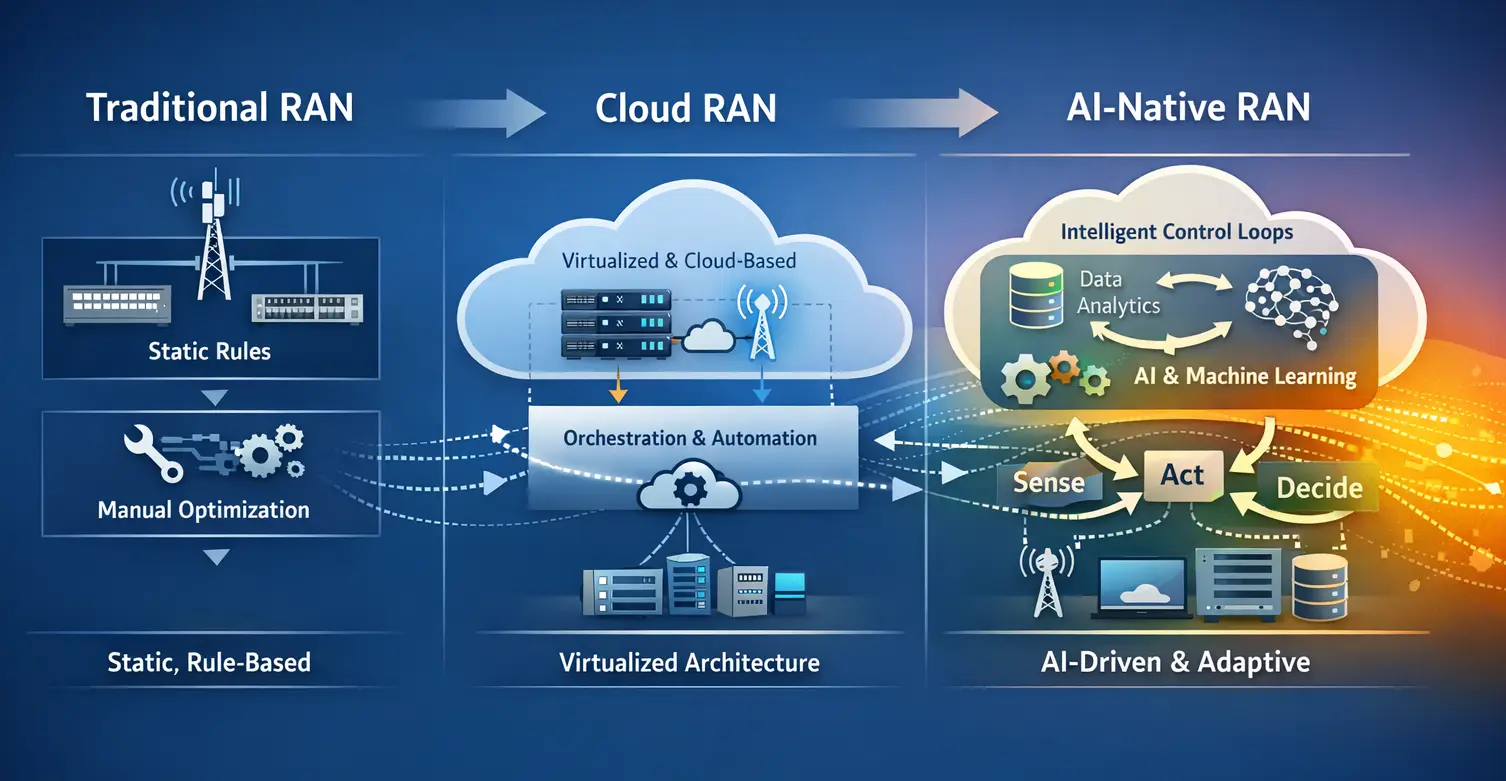
Historically, RAN performance has been managed using deterministic rules, static thresholds, and manual optimization workflows. These approaches struggle in modern environments characterized by:
- Highly variable traffic patterns
- Massive device density
- Spectrum fragmentation
- Multi-vendor and Open RAN architectures
- Stringent latency and reliability requirements
AI RAN replaces rigid control logic with learning-based decision systems. Instead of reacting to faults or congestion after the fact, AI-enabled RAN can predict, adapt, and optimize in real time.
This transition is not simply about adding analytics dashboards. It requires:
- Continuous data ingestion from the radio layer
- AI models embedded into control loops
- Cloud-native RAN architectures capable of scaling compute and intelligence dynamically
In effect, the RAN evolves from a passive access layer into an active decision-making system.
AI Across RAN Timescales
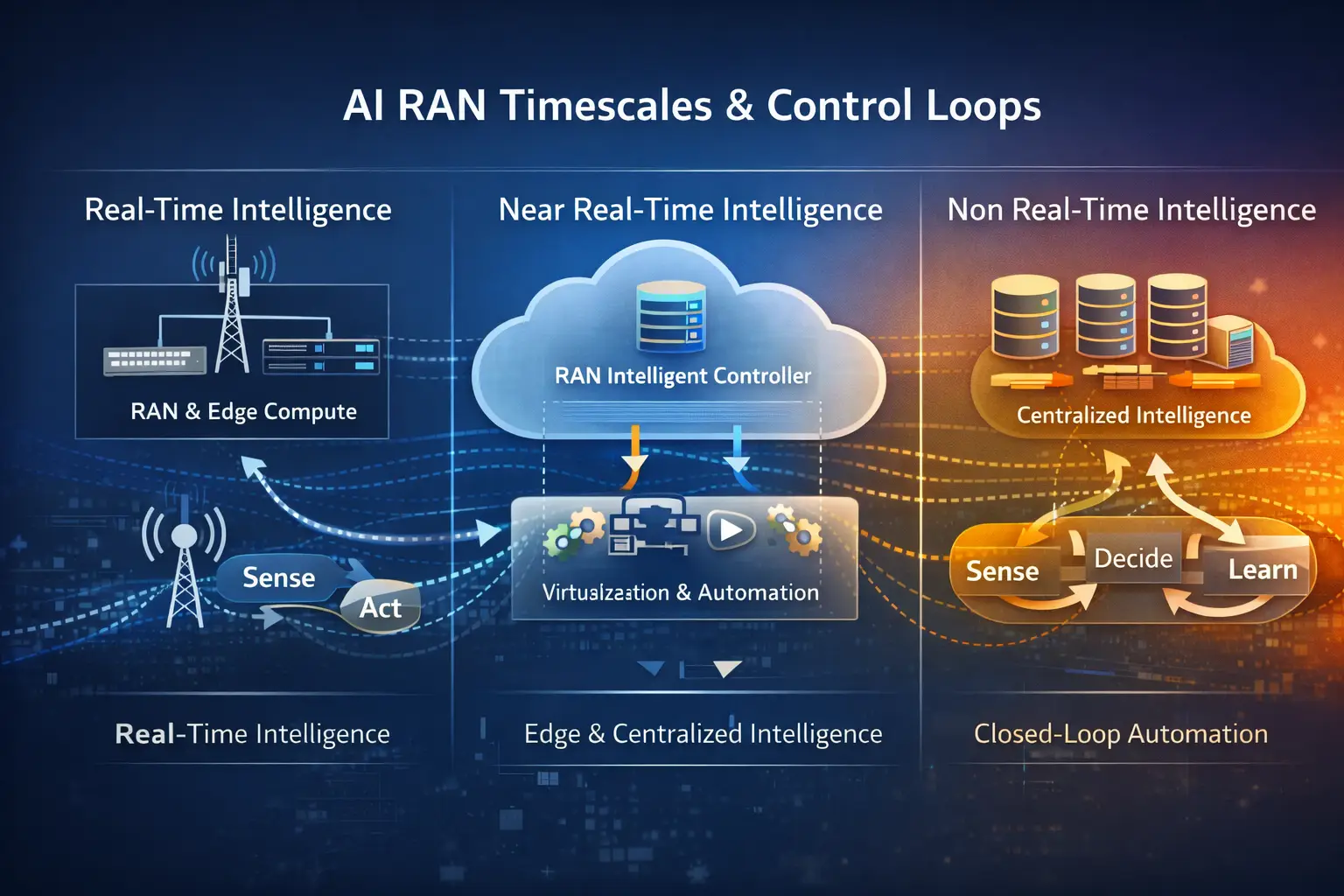
A defining characteristic of modern AI RAN is its operation across multiple timescales, each serving different optimization objectives.
Real-Time Intelligence (Milliseconds to Seconds)
At the lowest latency levels, AI supports:
- Dynamic beamforming and Massive MIMO optimization
- Interference mitigation in dense deployments
- Scheduling and mobility decisions
These functions directly impact user experience and radio efficiency and require inference close to the edge.
Near-Real-Time Intelligence (Seconds to Minutes)
At this level, AI enables:
- Load balancing across cells and carriers
- Traffic-aware handover optimization
- Energy-saving actions such as carrier or cell sleep modes
This layer is critical for maintaining performance during demand fluctuations.
Non-Real-Time Intelligence (Hours to Days)
Longer-term AI models support:
- Capacity planning and spectrum strategy
- Predictive maintenance and fault forecasting
- Policy optimization and configuration management
Together, these layers form closed-loop automation, allowing the network to learn from its own behavior.
AI RAN and Energy Efficiency
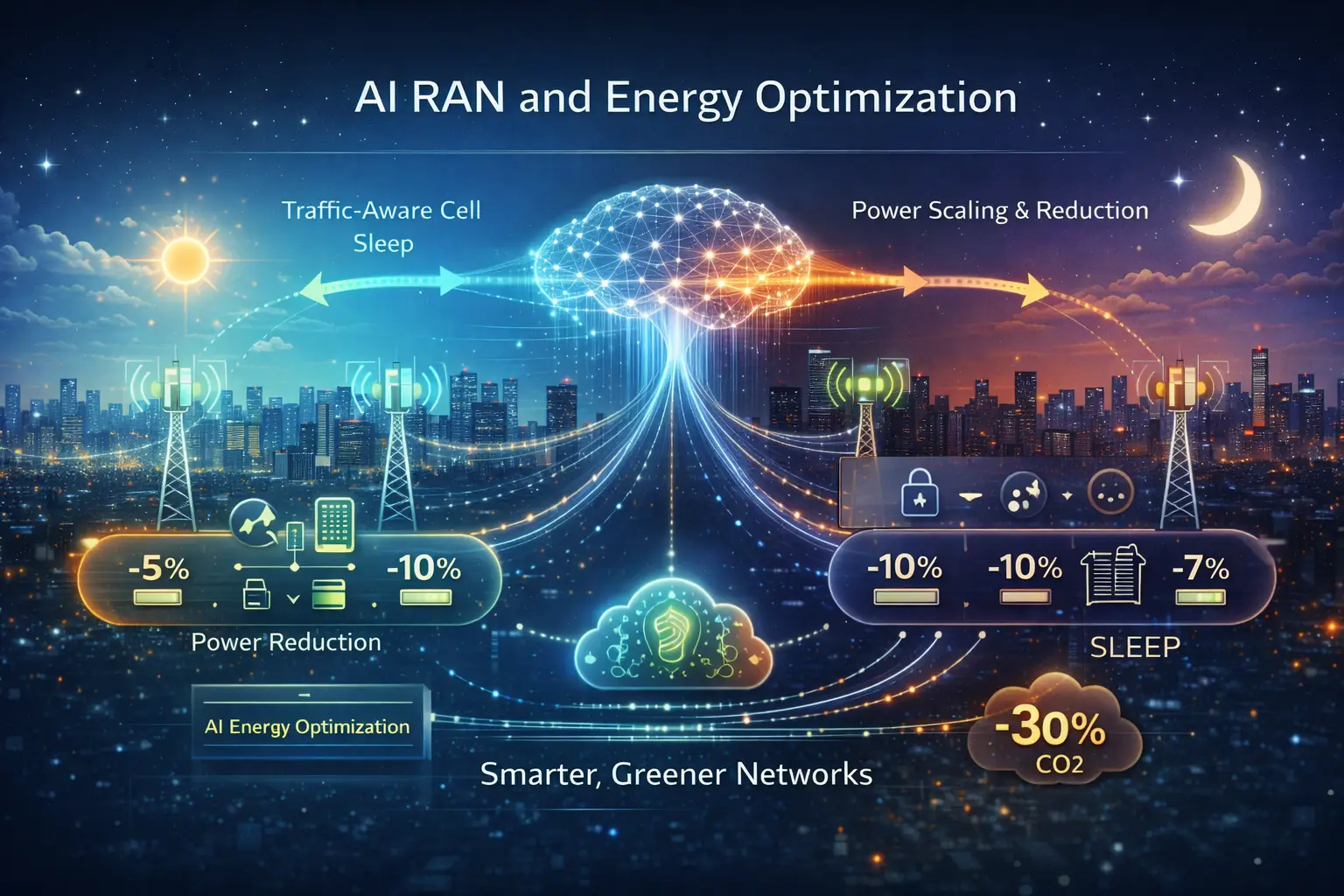
Energy consumption is now one of the dominant cost and sustainability challenges facing mobile networks. AI RAN is rapidly becoming a key enabler of energy-aware network operations.
AI-driven capabilities include:
- Traffic-adaptive radio shutdown and power scaling
- Predictive energy optimization based on demand forecasts
- Coordination between RAN, transport, and data center energy systems
For operators and smart city authorities, this directly supports:
- Net-zero commitments
- ESG reporting requirements
- Reduced operational expenditure
AI RAN transforms energy management from static engineering margins into continuous optimization.
AI RAN, Open RAN, and Multi-Vendor Complexity
Open RAN introduces flexibility and vendor diversity—but also operational complexity. AI is increasingly essential to make Open RAN commercially viable at scale.
AI RAN helps:
- Normalize telemetry across disaggregated vendors
- Automate optimization that would otherwise require manual tuning
- Maintain performance consistency in heterogeneous environments
For governments and regulators pursuing vendor diversification and digital sovereignty, AI RAN is a strategic enabler, not an optional feature.
AI RAN and Autonomous Network Operations
AI RAN is a foundational component of the industry’s move toward zero-touch and autonomous networks, as defined by TM Forum and other industry bodies.
By enabling closed-loop control, AI supports:
- Automated fault detection and remediation
- Intent-based network configuration
- Reduced dependency on manual intervention
This is not about eliminating engineers—it is about allowing skilled teams to focus on strategy, architecture, and service innovation rather than constant firefighting.
AI RAN for Private Networks and Industry Verticals
One of the fastest-growing applications of AI RAN is in private and mission-critical networks, where performance guarantees matter more than raw throughput.
Key sectors include:
- Manufacturing and Industry 4.0
- Ports, airports, and logistics hubs
- Energy, utilities, and mining
- Smart campuses and smart cities
AI RAN enables:
- Deterministic latency behavior
- SLA-driven radio policies
- Predictable performance under variable load
For enterprises, this transforms private 5G from a connectivity upgrade into operational infrastructure.

Edge Computing and AI Deployment Models
AI RAN is closely linked to edge computing. While model training often occurs centrally, real-time inference must run close to the radio to meet latency requirements.
This introduces new considerations:
- Compute and power availability at RAN sites
- Integration with MEC platforms
- Hardware acceleration and lifecycle planning
These factors increasingly influence site design, power strategy, and network architecture decisions.
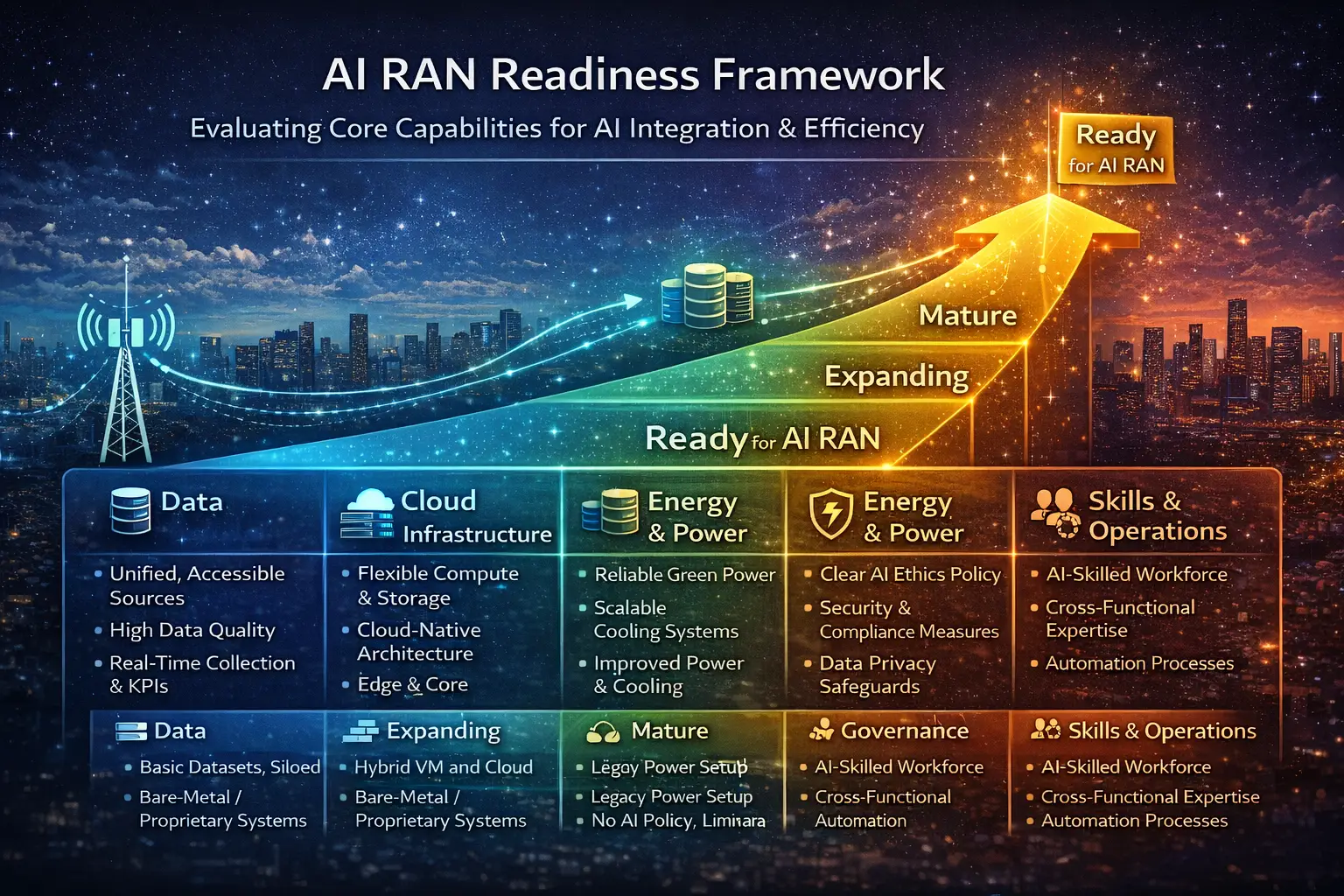
AI RAN Readiness: Strategic Questions for Decision-Makers
Despite strong momentum, AI RAN success is not guaranteed. Organizations must address several readiness challenges:
- Is telemetry data accurate, complete, and usable?
- Is the RAN architecture cloud-native and scalable?
- Are governance and explainability frameworks in place?
- Is site power and cooling adequate for edge compute growth?
- Are operating models aligned with AI-driven automation?
Without addressing these foundations, AI RAN risks becoming fragmented pilot projects rather than a scalable capability.
Turn AI RAN from Ambition into Operational Advantage
Independent, infrastructure-led AI RAN strategy that aligns radio intelligence with power, energy, cloud, and long-term network value. Contact Us Today!
How Azura Consultancy Supports AI RAN Transformation
Azura Consultancy supports clients across the full AI RAN lifecycle, from strategy to execution:
RAN Strategy and Feasibility
- AI RAN readiness assessments
- Open RAN and vendor strategy evaluation
- Energy and sustainability impact analysis
- Business case and ROI modeling
Technical Due Diligence
- AI RAN architecture reviews
- Cloud RAN and edge compute assessments
- Multi-vendor risk analysis
- Regulatory and security considerations
Smart Cities and Public Infrastructure
- AI-enabled RAN planning for smart city deployments
- Integration with data centers, edge platforms, and power systems
- Energy-efficient and future-ready network design
Private and Industrial Networks
- AI RAN design for deterministic performance
- SLA-driven radio and network architectures
- Long-term scalability and operational governance
Azura’s role is not tied to any single vendor or platform. We provide independent, technically grounded advice that aligns network intelligence with business, sustainability, and infrastructure goals.
AI RAN on the Path to 6G
AI RAN is not an end state—it is a stepping stone toward cognitive, intent-driven networks that will define the 6G era. The decisions made today around architecture, power, governance, and automation will shape network capabilities for the next decade.
Organizations that treat AI RAN as a strategic infrastructure choice—not a software add-on—will be best positioned to scale, adapt, and compete in an increasingly connected world.